
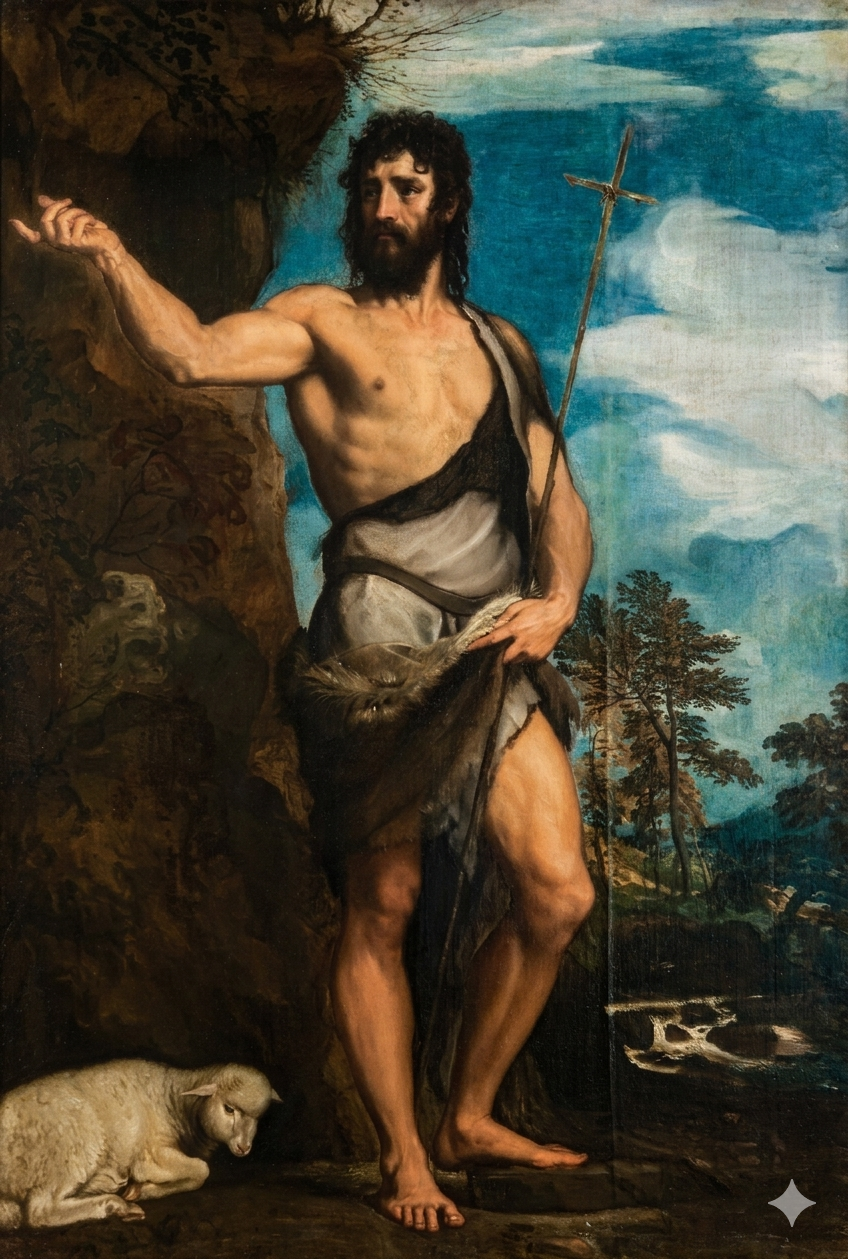
The Feast of St John the Baptist invites the Church to contemplate the mystery of the one whom St Augustine calls “the boundary between the Old and the New Testament.” John’s mission was to prepare Israel for the coming of Christ through repentance. Likewise, the Fatima message calls humanity to conversion, penance, and the triumph of the Immaculate Heart of Mary.
St Thomas Aquinas teaches that John the Baptist received a unique grace: he was sanctified in his mother’s womb, becoming the first to recognise Christ’s presence. John leaps before the unborn Christ, carried by Mary. As St Ambrose notes, “Elizabeth heard the voice of Mary, but John felt the grace.” In this encounter, the missions of John and Mary converge: John announces the Messiah; Mary bears Him. Their hearts are united in pointing humanity toward the Word made flesh. This unity illuminates the message of Fatima.
When Our Lady appeared in 1917, she echoed John’s cry: “Repent, for the Kingdom of God is at hand.” But she spoke with the tenderness of a Mother whose Heart is wounded by sin. St John Chrysostom teaches that true repentance is not fear‑driven but love‑driven by turning our heart toward God. Mary calls for conversion at Fatima, is not as a judge but as a Mother whose Immaculate Heart burns with Love for her children. St Bernard of Clairvaux teaches that Mary is the “aqueduct of grace,” the channel through which Christ’s redemptive love flows into the world. Devotion to her Immaculate Heart is centred on Christ himself. St Louis de Montfort, echoing this tradition, insists that Mary’s Heart is the surest path to union with Jesus because her will is perfectly aligned with His.
St John the Baptist’s mission, which is to prepare the way, finds its spiritual continuation in Mary’s maternal mission. John prepared Israel for Christ’s first coming; Mary prepares the Church for the triumph of divine love in the world. John called for repentance through baptism in water; Mary calls for repentance through prayer, penance, and reparation. Both point toward the same mystery: the renewal of humanity in Christ.
Fatima’s call to the Five First Saturdays, the Rosary, and acts of reparation reflects what St Catherine of Siena describes as “co‑redemptive love”. While not adding to Christ’s sacrifice, we participate in its fruits through charity. Mary invites the faithful to share in her maternal sorrow for sin and her maternal hope for the salvation of souls.
As we celebrate the feast of St John the Baptist, we recognise that his prophetic voice and Mary’s maternal plea form a single thread: a summons to conversion, a preparation for grace, and an invitation to enter the burning charity of the Immaculate Heart of Mary, which always leads to the Heart of Christ.
Bibliography
- St Augustine, Sermons, esp. Sermon 293 on John the Baptist
- St Thomas Aquinas, Summa Theologiae, III, q. 27–28 (on sanctification in the womb)
- St Ambrose, Commentary on Luke, Book 1
- St John Chrysostom, Homilies on the Gospel of Matthew, esp. Homily 10 (on repentance)
- St Bernard of Clairvaux, Sermons on the Blessed Virgin Mary
- St Louis de Montfort, True Devotion to the Blessed Virgin
- St Catherine of Siena, The Dialogue
- Sr. Lucia of Fatima, Memoirs of Sister Lucia
- The Holy Bible, esp. Luke 1; Matthew 3; John 1
- Catechism of the Catholic Church, sections on Mary (963–975) and repentance (1427–1433)