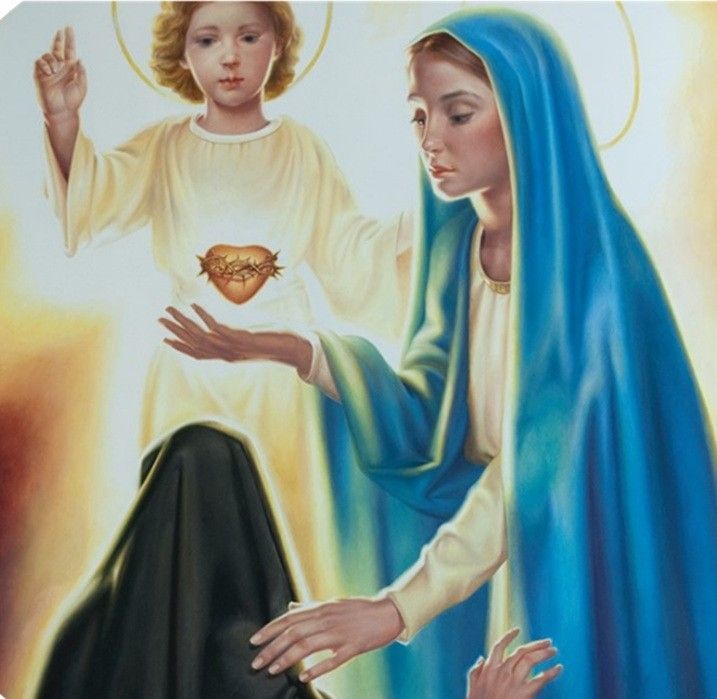
By 1925 Lucia, who was now 18, had become a postulant with the Sisters of St Dorothy at Pontevedra in Spain, and on Thursday 10 December, the Blessed Virgin appeared to her and by her side, elevated on a luminous cloud, was the Child Jesus. Lucia recounted that Mary rested her hand on her shoulder, while showing her a heart encircled by thorns which she was holding in her other hand.
The Child Jesus spoke first: “Have compassion on the Heart of your Most Holy Mother. It is covered with the thorns with which ungrateful men pierce it at every moment, and there is no one to remove them with an act of reparation.”
Then Mary said:
“My daughter, look at My Heart surrounded with thorns with which ungrateful men pierce me at every moment by their blasphemies and ingratitude. You, at least, try to console me, and say that I promise to assist at the hour of death, with the graces necessary for salvation, all those who, on the first Saturday of five consecutive months go to confession and receive Holy Communion, recite five decades of the Rosary and keep me company for a quarter of an hour while meditating on the mysteries of the Rosary, with the intention of making reparation to me.”
The Child Jesus again appeared to Lucia in February 1926 to encourage her to propagate this devotion, and additionally on the night of 29-30 May 1930, as she was praying before the Blessed Sacrament, she received an interior locution from Our Lord in which He said that people who had difficulty in getting to confession on the Saturday could do so within eight days, or longer still, provided that “when they receive Me they are in the state of grace and have the intention of making reparation to the Immaculate Heart of Mary” (Fatima in Lucia’s Own Words, vol I, pp. 193-196).
Also, Our Lord explained that the Communion of Reparation was to be made on five first Saturdays in reparation for the five kinds of offences and blasphemies uttered against Our Lady, namely: blasphemies against the Immaculate Conception, against Our Lady’s perpetual virginity, against her divine maternity and refusal to recognise her as the mother of mankind, blasphemies by those seeking to alienate children from her, and in reparation for those who outrage Our Lady in her sacred images.When we come together to pray in the presence of Jesus and Mary, we are on the threshold of the divine mystery which is perceived not with the senses but with the eyes of faith. This is the point where, in order to proceed and enter into this mystery, we need to be sensitive to who we are, as His creatures, made in His image and likeness, and into Whose divine Presence we are entering. To do this we need to dispose ourselves in a way that corresponds to what we believe.
When you go to a concert that you know is going to be special, you want to enjoy it as fully as possible. Hence you take care that you sit in the best place in which to relax, so that you can forget about everything else and let yourself be absorbed into the uplifting music. The atmosphere of the concert hall and the people you are with, all help to heighten one’s enjoyment of the experience.
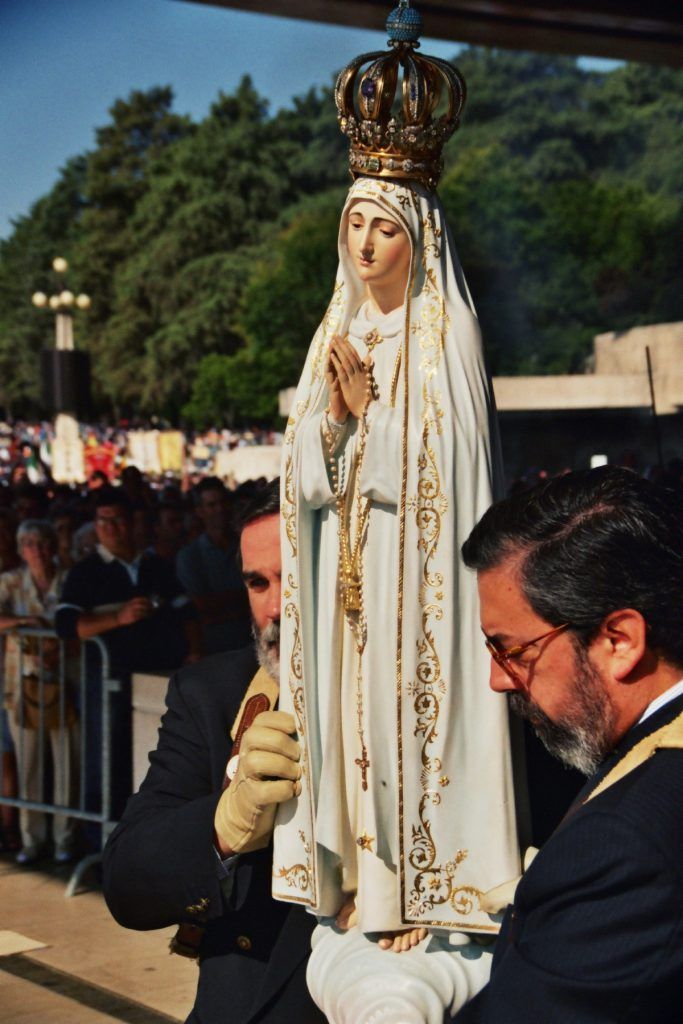
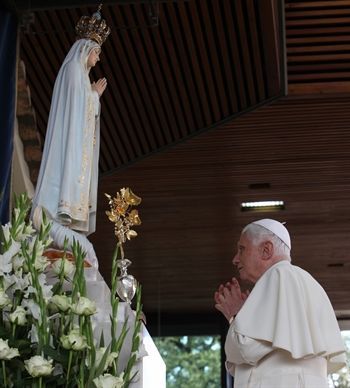
This is how it should be in our Rosary prayer. With a little effort, we can create an atmosphere which disposes us more readily to believe. Put up an image or a prayer card of Our Lady, with perhaps some flowers, light a candle in front it, and maybe dim the lights.
We know by faith that in our prayer, Jesus and Mary will come to us. “Where two or three are gathered in my name, there am I in the midst of them” (Mt 18: 20), and Mary herself likewise prays with us when we pray the Rosary, as Pope John Paul II said. They will come to us because we have chosen this precious moment in which we want to unite ourselves with them in prayer.
So let us prepare our hearts and minds for this important meeting with a moment of quiet, in which to lift up our thoughts to God. Try to imagine in your mind that your heavenly Mother is there in person—as indeed she is, albeit invisibly. This helps to lift one’s spirit to her, and also to remove distractions and the risk of saying the words of the prayer mechanically.