
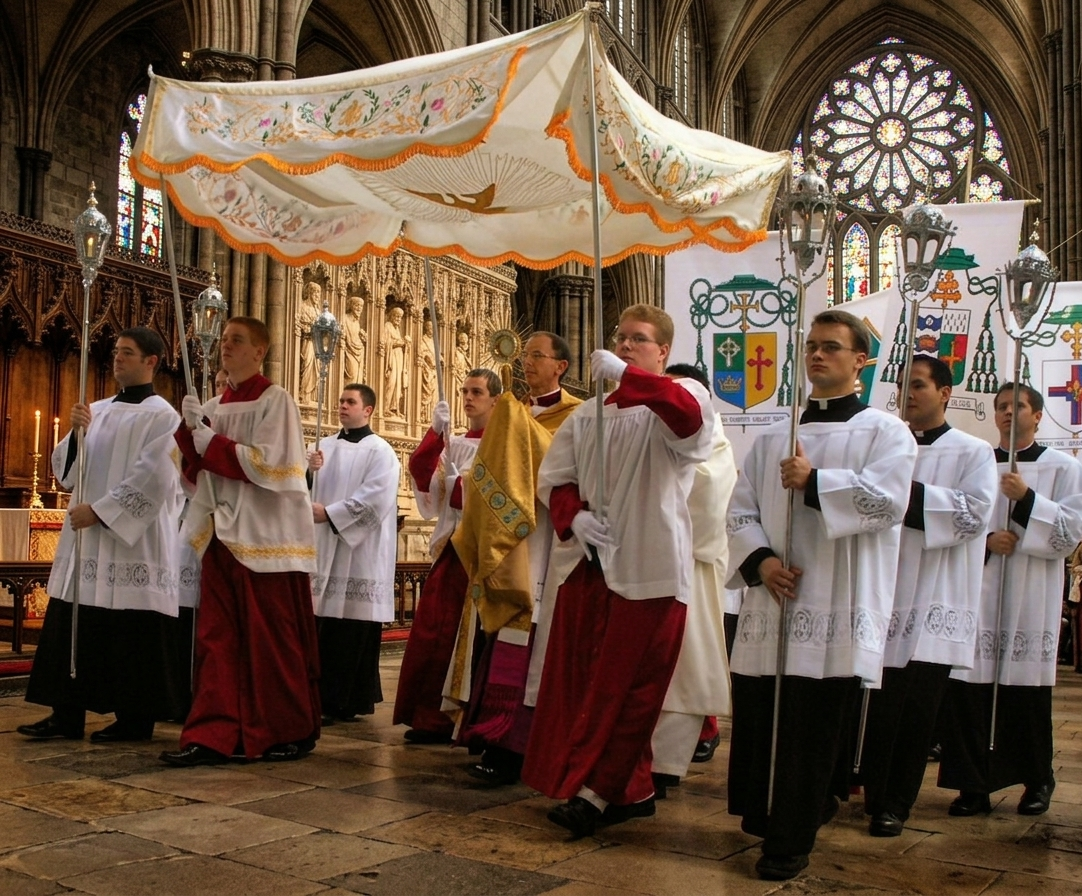
The Feast of the Body and Blood of Christ 'Corpus Christi', is one of the Church’s most luminous celebrations. It is the feast that reminds us not only what we believe, but who we are: a Eucharistic people, shaped and sustained by the real presence of Jesus Christ. Through the teachings of St Peter, St Paul, and the message of Our Lady of Fatima, this feast becomes a profound call to holiness, unity, and conversion.
It is not a coincidence that the Church often celebrates the Immaculate Heart of Mary near Corpus Christi. Mary shows us how to approach the Eucharist: with purity of intention, with humility, and with a willingness to let Christ reshape our lives from within.
Mary’s Heart is the model of Eucharistic devotion because her Heart is:
- Receptive as she receives the Word fully and without resistance.
- Contemplative since she “keeps all these things and ponders them” (Lk 2:19).
- Self‑giving for she offers her whole life in union with her Son.
St Peter, the first shepherd of the Church, invites us all to “Be holy in all you do”. For Peter, holiness is the natural fruit of belonging to Christ. He describes the Church as a “spiritual house” built of “living stones.” The cornerstone of that house being Christ Himself, and the Eucharist is the sacramental way Christ remains with us. We become living stones only because we receive the Living Bread. Peter also emphasises to “Clothe yourselves with humility”, the same humility of Christ hidden in the Host. Eucharistic devotion is, at its heart, an act of humble recognition: God comes to us in silence, in stillness, in a form that invites adoration rather than spectacle. This call to holiness and humility resonates strongly with the message of Fatima, where Our Lady urges the faithful to conversion, penance, and purity of heart; dispositions that flow naturally from a Eucharistic life.
If Peter teaches us how to live the Eucharist, St Paul teaches us what the Eucharist is. His writings contain the earliest account of the Last Supper and the clearest articulation of the Real Presence. Paul asks the Corinthians: “Is not the cup of blessing we bless a participation in the Blood of Christ?” For him, the Eucharist is not symbolic. It is a participation, a real sharing in the life of Christ. Paul’s teaching on the Mystical Body, that we are many members yet one body, flows directly from the Eucharist. To receive Christ is to be united not only with Him but with all who belong to Him. The Eucharist is therefore the sacrament of unity, reconciliation, and charity. He also insists on self-examination before receiving Communion. This is not meant to discourage but to awaken reverence and echo the Fatima message. The Angel teaches the children to make acts of reparation for sins committed against the Eucharistic Lord. Paul’s teachings remind us that Corpus Christi is not a feast to admire but a mystery to enter. Just as at Fatima, the Angel taught the children a prayer of Eucharistic adoration and reparation, linking devotion to the Immaculate Heart with love for the Blessed Sacrament.
To honour Mary’s Immaculate Heart is to learn how to receive Christ with purity, attentiveness, and love. It is to allow her to lead us more deeply into the mystery of the Eucharist, since Mary is the first tabernacle who carries the Body of Christ within her.
When we bring together Peter’s call to holiness, Paul’s teaching on communion, and Mary’s message at Fatima, a powerful truth emerges:
The Eucharist is the source of holiness, unity, and reparation for the world.
- Holiness (St Peter): The Eucharist forms us into a people set apart.
- Communion (St Paul): The Eucharist binds us to Christ and one another.
- Reparation (Fatima): The Eucharist calls us to console the Heart of Jesus and intercede for sinners.
Corpus Christi is not only a celebration but a real mission for all. The Eucharist is Christ’s Sacred Heart given to us. The Immaculate Heart of Mary is humanity’s perfect response. Our task is to let these two Hearts shape our own.
Bibliography
- Holy Bible — Key passages: Lk 2:19; 1 Pt 1–2; 1 Cor 10–11.
- Catechism of the Catholic Church — Sections on the Eucharist (1322–1419) and Mary (963–975).
- Lumen Gentium — Vatican II’s teaching on the Church and the Blessed Virgin Mary.
- Ecclesia de Eucharistia — St John Paul II on the Eucharist as the heart of the Church.
- Fatima in Lucia’s Own Words — Accounts of the Angel’s Eucharistic prayers and Our Lady’s message.
- St Thomas Aquinas on the Eucharist — Summa Theologiae III, 73–83.
- St Augustine’s Eucharistic Sermons — Early reflections on the Mystical Body and Real Presence