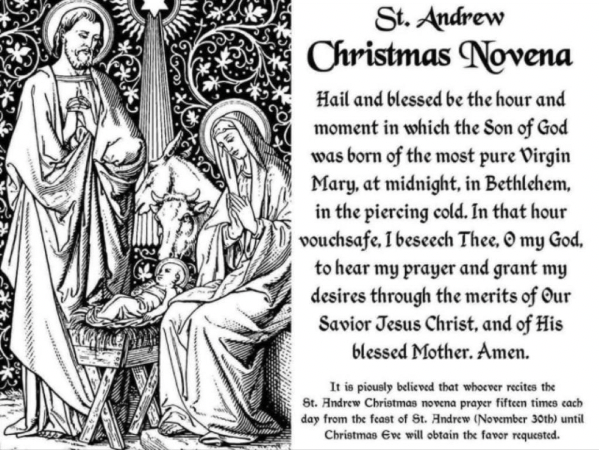
A Christmas Novena
Webmaster
A beautiful Christmas Novena by St. Andrew, to help us prepare for the arrival of Our Lord Jesus.


Some quotes from Popes and Saints about Advent St. Ambrose of Milan: “Open wide your door to the one who comes. Open your soul, throw open the depths of your heart to see the riches of simplicity, the treasures of peace, the sweetness of grace. Open your heart and run to meet the Sun of eternal light that illuminates all men” St. John Chrysostom: “Let us prepare for the coming of our Lord with repentance, humility, and acts of charity, for through these the soul adorns itself for the King.” St. Alphonsus Liguori: “During Advent, we learn how to die to ourselves so that Christ may be reborn in our hearts.” Pope Leo XIII: “The progression of the Advent season is like the increasing light from the dawn until the rising sun; we must let this light ignite the flame of charity in our souls.” Pope Pius XI: “Advent is that time of year when the Church prepares herself spiritually for the coming of the Redeemer, the long-awaited Messiah, who brings light into the darkness of the world.” Pope Paul VI: “Let Advent be a spiritual journey toward the Christmas mystery, where there will be found a humble manger, a child who is God himself. Let us prepare ourselves to receive him fully in our hearts.” St. Teresa of Calcutta: “Are we ready to receive Him? Before the birth of Jesus, His parents asked for a simple dwelling place, but there was none. If Mary and Joseph were looking for a home for Jesus, would they choose … your heart, and all it holds? Let us pray that we shall be able to welcome Jesus at Christmas...” St. Pope John Paul II: “Mary sustains our journey toward Christmas, for she teaches us how to live this Advent Season in expectation of the Lord.” Pope Benedict XVI: “Advent is the spiritual season of hope par excellence, and in this season the whole Church is called to be hope, for itself and for the world”.

December 10, 2025, marks the momentous centenary of the apparitions in Pontevedra, Spain , where the Child Jesus and the Blessed Virgin Mary appeared to Sister Lúcia dos Santos, the eldest of the Fatima visionaries. This sacred anniversary is a powerful call to renew the practice of the First Five Saturdays Devotion , which is an essential part of the Fatima message. During the apparition, the Child Jesus made a heartfelt plea to Lúcia: "Have compassion on the Heart of your Most Holy Mother, covered with thorns , with which ungrateful men pierce it at every moment, and there is no one to make an act of reparation to remove them." The devotion's primary aim is reparation —a loving effort to console the Immaculate Heart of Mary for the sins and blasphemies committed against her. It is an act of mercy towards Our Lady and, through her, a profound act of love for God. In return, Our Lady promises extraordinary graces to the faithful, at the hour of death for those who embrace the devotion. The requirements are confession, receiving Holy Communion, reciting the Rosary, and keeping our Holy Mother company for 15 minutes whilst meditating on the mysteries, all to take place on the first Saturday of five consecutive months with the intention of making reparation to the Immaculate Heart of Mary. This centennial year offers a unique spiritual opportunity for Catholics to embrace this path to peace and personal salvation. The First Saturdays Devotion was approved at the diocesan level by José Alves Correia da Silva , the local bishop of Leiria-Fátima , on September 13, 1939, in Fátima. Its significance has also been recognised by the Catholic Bishops' Conference of England and Wales (CBCEW) which demonstrated its support with a May 2025 resolution: " The Bishops of England and Wales... commend the Five First Saturday’s devotion as a fruitful means to enter into [a] renewal [of faith], especially in their love for the Eucharist and the sacraments." Let us unite in prayer, seeking the graces promised by Our Lady and offering our collective act of reparation, by promoting the devotion throughout the dioceses of England and Wales. By this simple act of obedience to Jesus’ request to make Our Holy Mother known and loved we can help save souls. ๏ปฟ Footnote: The Child Jesus appeared again on February 15, 1926, and addressed concerns about the Saturday confession requirement. He clarified that confession within eight days was acceptable, provided the intention of reparation was present at Communion. He also addressed those who forgot the intention, stating they could rectify it at their next confession. On the night of May 29-30, 1930, Jesus explained to Lucia the necessity of five Saturdays of reparation, correlating them with the five types of offences against Mary’s Immaculate Heart: against her Immaculate Conception, her Virginity, her Divine Maternity and spiritual motherhood, offences from those who instil indifference or hatred towards her in children, and outrages against her holy images.

Advent: Preparing through Prayer for Christmas Last weekend, we celebrated the First Sunday in Advent, our yearly time of preparation for Christmas. The season of Advent is primarily about the birth of Christ in Bethlehem, two thousand years ago, his first Coming into the world, but it also looks forward to Christ’s second coming at the end of time. In both cases it is a question of a time of anticipation, as we look forward to the celebration of Christ’s first coming in humility and silence – a coming which is repeated for us each year at Christmas – and then more remotely look forward to his final coming in great glory and power. As we advance through the Advent season, we are called to go deeper into the mystery of Christmas, into a greater and more meditative spirit of silence. This has always been difficult, but the modern world, with all its noise and activity, especially as Christmas Day approaches, makes this effort at prayer even more difficult. Some of this activity is of course necessary, but as a whole it can become a distraction as we prepare for Christmas. Our lady and St Joseph set out for Bethlehem for the Emperor’s census with an attitude of silent expectation. It would be good to imitate them as we get closer to Christmas Day and resist the temptation to get so involved in preparations that we lose sight of the whole reason for the celebrations in the first place. Just imagine how the Blessed Virgin must have felt as she rode along on the donkey, with St Joseph at her side, on the rough roads towards Bethlehem. The unborn Child Jesus was in her womb, and she was filled with the Holy Spirit and with a longing for the time of His birth. The Angel Gabriel had told her marvellous things about the Child – that he would be great and the Son of the Most High, that he would inherit the throne of his ancestor David and rule over the House of Jacob for ever. But that was all in the future, and for now, she and St Joseph were poor travellers quietly making their way southwards from Nazareth to Bethlehem. As they journeyed along, they Blessed Virgin would have had time to ponder what the Angel had told her in the light of what she must have known from the works of the Hebrew prophets in the Scriptures. And so she could meditate on the joyous aspects of the forthcoming birth of her Child, just as we do in the joyful mysteries of the Rosary. It was strangely providential that once they arrived there was “no room at the inn,” since that would have provided no privacy for the Holy Family, at the very time when they needed a refuge from the world’s noise. Instead, they sheltered in the cave on the outskirts of Bethlehem away from the bustle of the town. And so, despite the hardships of the journey, and the poor reception they received in Bethlehem, this was a time of joyful contemplation for Mary. This ought to be the key, then, as to how we celebrate the days leading up to Christmas Day, that is in union with Our Lady and St Joseph in an attitude of prayerful expectation and love, pondering in silence the awesome events that are to unfold before us in the liturgy, just as they occurred in real life all those centuries ago. In a practical sense, this means we should set aside some time each day from now until Christmas, to quietly and prayerfully reflect on some aspect of the story of the Nativity. A good way to do this would be to take the readings from the Daily Mass and carefully meditate on them each day. Another way would be to read some pages every day from a Fatima book such as Fatima in Lucia's own words , or Sr Lucia's Calls book . Or there are some Advent & Christmas Prayers & Reflections online here: https://mycatholic.life/advent/ Even if we could only spend five or ten minutes each day in prayer or meditation, it would surely have a very beneficial effect, and this effect would be further enhanced if we could also call to mind the main themes of each day’s reading, or our meditations, from time to time during the day. If we can do that, then, by Christmas day, we will be in a much better spiritual condition to prayerfully contemplate, along with Our Lady and St Joseph, the newborn Child in the manger and come to a better understanding of his love for us.

World Apostolate of Fatima (England and Wales) Pilgrimage to Braga and Fatima 9th th – 15 th July 2026 Day one - Thursday 9 th July 2026 (London-Porto-Braga) Flight from UK to Porto. (LGW/Porto – Easyjet 1005 / 1300) Meet our coach and guide and transfer to our accommodation in Braga. Time to see Braga. Dinner is provided at the hotel. Day two – Friday 10 th July 2026 (Braga-Balazar) After breakfast we begin our visit to the city of Braga and the Shrine of Sameiro and Bom Jesus. We break for lunch. In the afternoon pilgrimage to Balazar to pray at Blessed Alexandrina’s tomb. Mass in the chapel. Dinner and overnight accommodation at our hotel. Day three – Saturday 11 th July 2026 (Porto-Aveiro-Coimbra-Fatima) After breakfast we check out of our hotel in Braga and travel by coach to Porto. Free time to tour the city in the morning and enjoy lunch. In the afternoon we travel towards Fatima, stopping en route in Aveiro. We travel on to Coimbra and visit the Museum of Sister Lucia and say Rosary at the Convent Chapel. Check in at Domus Pacis hotel in Fatima and dinner. Day four – Sunday 12 th July 2026 (Fatima) Breakfast in the hotel Holy Mass in Domus Pacis or Shrine. We then have free time to independently tour the Sanctuary. Free for lunch. Visit to the House of Candles for a guided tour. 7.30 pm - Dinner at the hotel 9.30 pm - Participation in the evening Vigil We return to our hotel for our overnight accommodation. Day five – Monday 13 th July 2026 (Fatima) After breakfast we join the congregation for the International Mass in the Piazza of the Shrine of Fatima. Free for lunch 2.30 pm – We meet for talk of Nuno and Ana at Domus Pacis Chapel. 4.00 pm - Visit to the museum of Fr Formigao. 6.00 pm Fatima Prayer Cell at the Library of Domus Pacis. 7.30 pm Dinner 9.30pm Rosary and Candlelight procession Day six – Tuesday 14 th July 2026 (Fatima) After breakfast we depart by coach walk the Stations of the Cross. We visit the site of the Apparition of the Angel and celebrate Mass at St Stephen’s chapel. We then walk into the village of Aljustrel where we break for lunch before visiting the homes of the children. We return by bus to St Anthony’s Church for a renewal of baptismal promises. Return to the hotel. 7.30 pm Dinner 9.30pm Rosary and Candlelight procession Dinner and overnight accommodation in Fatima. Day seven – Wednesday, 15 th July 2026 (Fatima-Lisbon) After breakfast we check out of our hotel and depart for Lisbon. En route we visit Santerem before moving on to the Shrine of St Anthony where we celebrate Mass. We also visit the Convent of the Poor Clares where Jacinta stayed whilst waiting for a hospital bed. We travel on to the airport for our return flight to the UK. (1720/1955 LIS/LGW)Day 1 – Thursday, 9 July (London–Porto–Braga) Flight from London Gatwick to Porto. Transfer to Braga with time to explore the city. Dinner at the hotel. Day 2 – Friday, 10 July (Braga–Balazar) Visit Braga’s religious sites: Shrine of Sameiro and Bom Jesus. Afternoon pilgrimage to Balazar to pray at Blessed Alexandrina’s tomb. Mass and dinner at the hotel. Day 3 – Saturday, 11 July (Porto–Aveiro–Coimbra–Fatima) Travel to Porto for sightseeing and lunch. Continue to Fatima via Aveiro and Coimbra. Visit Sister Lucia’s museum and pray the Rosary. Check-in and dinner at Domus Pacis hotel. Day 4 – Sunday, 12 July (Fatima) Mass at Domus Pacis or the Shrine. Free time to explore the Sanctuary. Guided tour of the House of Candles. Dinner and participation in the evening vigil. Day 5 – Monday, 13 July (Fatima) Attend the International Mass at the Shrine. Afternoon talks and visits: Domus Pacis Chapel, Fr Formigao Museum, and Fatima Prayer Cell. Evening Rosary and Candlelight procession. Day 6 – Tuesday, 14 July (Fatima) Stations of the Cross and Mass at St Stephen’s Chapel. Visit Aljustrel village and homes of the visionaries. Renewal of baptismal promises at St Anthony’s Church. Dinner and evening procession. Day 7 – Wednesday, 15 July (Fatima–Lisbon) Depart for Lisbon with stops at Santerem and the Shrine of St Anthony. Visit the Convent of the Poor Clares. Return flight to London Gatwick. Price: £1,370 per person sharing a twin/double room on a half board basis. Single rooms are available at a supplement of £190. Price includes return airfare including hold baggage, accommodation as detailed in the itinerary, all transport whilst in Portugal, and all entrance fees. Price does not include lunches, drinks or items of a personal nature. Please note that this itinerary is not suitable for the less able traveller. Deposit of £400 and completed booking form required by 15.12.2024 with balance and any single supplement due by 16.4.2026. Booking Ref: WAF02

The 8th Annual General Meeting of the World Apostolate of Fàtima England and Wales took place from 23-25 October 2025. This three-day event was a time of reflection, gratitude, planning, and prayer to strengthen the Apostolate’s mission of spreading Our Lady of Fàtima’s message across England and Wales. On Day 1, participants engaged in discussions focused on Promoters’ growth and contributions, Social Media and newsletters, and the Children of the Eucharist and Young Missionaries of Mary programs. Day 2 featured talks by two invited speakers: Antonia V Moffat on the connection between Consecration requests and the First Saturdays of Reparation, and Fr Lawrence Lew, OP, on the powerful theme of Redemptive Suffering in Fàtima’s message. The new Trustees elected were Ethel Lojo as National Treasurer and Anthony Hanley as a Board Member. ๏ปฟ Day 3 included an insightful session with Jerry Rivera about the Fàtima Prayer Cell program, which has been running for over four years. The event was led by National President Patrick Cunningham and Vice President Barbara Dixon, supported by National Secretary Kathleen Too, Aurea Ancheta Coloma, and Lucila Salonga Desbruslais. A special thanks was extended to Rev Fr Peter Sebastian, who celebrated the liturgies and hosted the AGM in his parish. The 9th Annual General Meeting will be held in November 2026, with details to be announced. May Our Lady’s Immaculate Heart be your refuge and guide you to God. Ave Maria.

On the first Saturday of October, the National Pilgrim Virgin Statue (NPVS ) of Our Lady of Fàtima and the Relics of Saints Francisco and Jacinta Marto visited the Cathedral of St John the Evangelist in Portsmouth. Bishop Philip Egan welcomed, crowned, and blessed the statue, relics, and the Centenary Icon of the Pontevedra apparition during Mass, attended by about 200 faithful from across the diocese. In his homily, Bishop Philip emphasized the Immaculate Heart of Mary and her call for conversion and reparation. ๏ปฟ He also led a 15-minute meditation and the recitation of the Joyful Mysteries of the Rosary. Canon James McAuley, Cathedral Dean and Vicar General, guided the veneration of the relics and welcomed the congregation. Fr Ryan Browne, the cathedral curate, presided over the enrollment and investiture of brown scapulars. May Our Lady's Immaculate Heart be your refuge and guide you to God.

How we can help the Holy Souls in November? November is the month of the Holy Souls and so this is an important time during which to remember our own loved ones, and more generally the souls in Purgatory. Regarding purgatory in the Catechism we find this passage: “The Church gives the name Purgatory to this final purification of the elect, which is entirely different from the punishment of the ... the tradition of the Church, by reference to certain texts of Scripture, speaks of a cleansing fire” (1031). Jesus certainly spoke about hell as a place of fire, of eternal punishment, (e.g. Mark 9: 43, 47; Luke 16:19-31), and the Church has traditionally seen purgatory as a lesser form of punishment—since unlike hell it will end—but still, according to some of the saints, an extremely painful experience, to the extent that the pains of purgatory surpass anything we could experience on earth. Thus, we should live our lives with the aim of entering heaven when we die. In any event, we can help the souls in purgatory particularly in November, but also at any time of the year, by visiting a cemetery and praying for particular souls, either vocally or mentally, so as to gain a partial indulgence on their behalf. And to go further, a Plenary Indulgence may be gained between 1st and 8th November, applicable to the Holy Souls only, by visiting a cemetery and praying there for the dead, even if the prayer is only mental, and then fulfilling the conditions required, which are Confession, (up to eight days before or afterwards), Holy Communion, and prayer for the intentions of the Pope (one Our Father and one Hail Mary).

Fr Lawrence Lew spoke powerfully about the redemptive value of suffering. His talk was both inspiring and illuminating, reminding us that our sufferings, when united with Christ’s Passion, become a powerful form of sacrifice. As Fr Lawrence said: “Suffering without love is hell. Suffering with love is a sacrifice which transforms and unites us with Christ on the Cross.”