
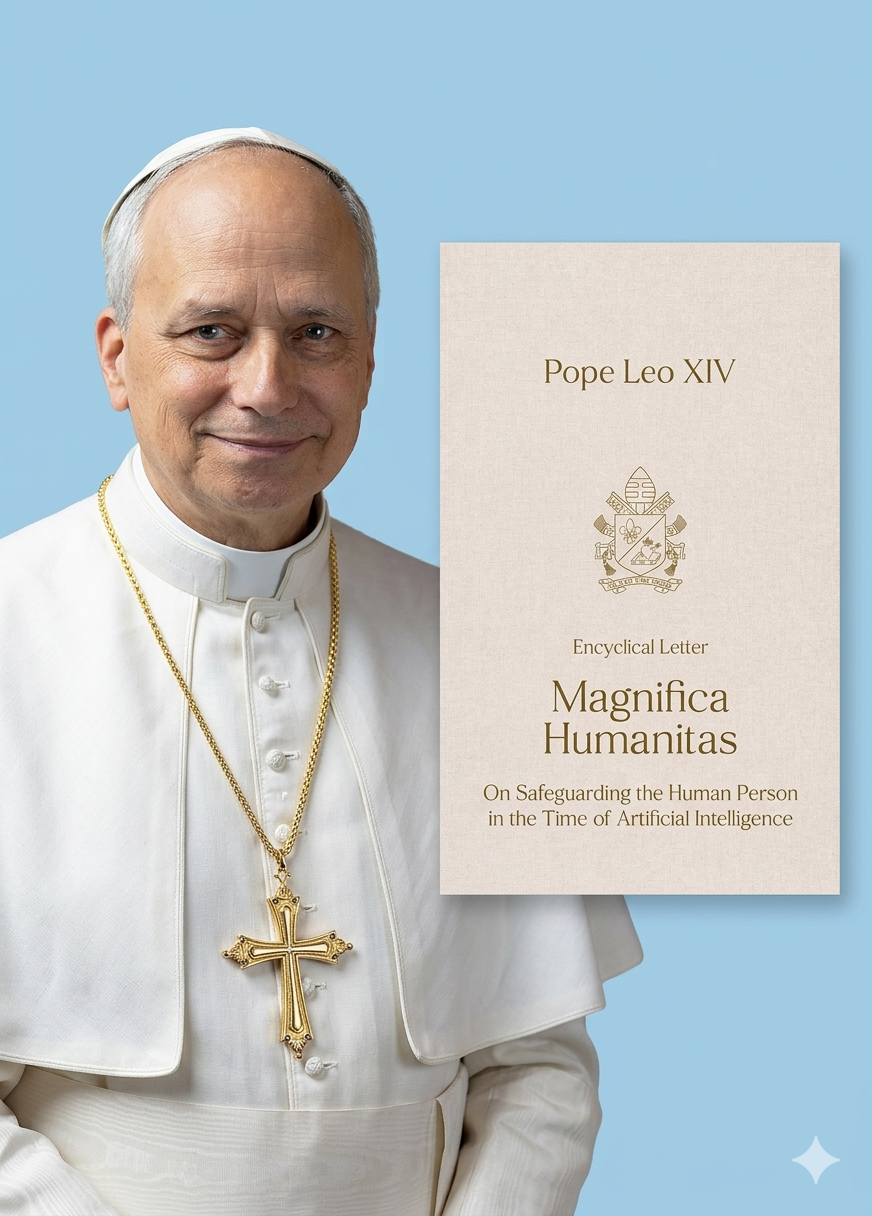
MAGNIFICA HUMANITAS (MAGNIFICENT HUMANITY), the first Encyclical Letter from Pope Leo XIV, which concerns the safeguarding of the human person in the time of artificial intelligence (AI).
He contrasts the construction of the Tower of Babel, an exercise in pride that led to confusion, to Nehemiah working with God’s people to rebuild the walls of Jerusalem. “Therefore, the primary choice is not between a ‘yes; or ‘no’ to technology, but rather between constructing Babel or rebuilding Jerusalem; between a power that claims to dominate the heavens and a people who work together in the presence of God to rebuild the walls of fraternal coexistence.” (9) The Holy Father reflects on the history of the development of Catholic Social Doctrine, beginning with Rerum Novarum (new things) issued in 1891 by Pope Leo XIII. “I believe that today we must once again reflect on the common good, the universal destination of goods, subsidiarity, solidarity and social justice.” (46) “Yet, there is still a long way to go to ensure that the rights of a great many, namely women, are equally and genuinely respected throughout the world.” (57) “A litmus test for social justice today is the treatment of migrants, refugees and those forced to move due to poverty, violence, climate change or environmental disasters.” (81) We must avoid the misconception of equating the AI type of intelligence with that of human beings. “These systems merely imitate certain functions of human intelligence. In doing so, they often surpass human intelligence in speed and computational capacity, offering tangible benefits across many fields. Yet this power remains entirely tied to data processing, So-called artificial intelligences do not undergo experiences, do not possess a body, do not feel joy or pain, do not mature through relationships and do not know from within what love, work, friendship or responsibility mean. Nor do they have a moral conscience, since they do not judge good and evil, grasp the ultimate meaning of situations, or bear responsibility for consequences.” (99) “In recent years, psychological and psychiatric literature have documented with growing insistence how early and unsupervised exposure to digital devices and social media can negatively impact sleep, attention span, control of emotions and relationships, especially during the most vulnerable stages of life, at times with tragic consequences.” (141) He reflects on the threat to people’s jobs. “Without bold decisions, the prospect of greater poverty and inequality looms large., which would leave many individuals marginalised, stranded and surrounded by the machines and automated systems that have replaced them.” (155) The Holy Father points to new forms of slavery linked to the digital economy, e.g. dangerous working conditions, human trafficking. In this context he acknowledges the involvement of the Church in traditional forms of slavery. “For this, in the name of the Church, I sincerely ask pardon.” (176) Speaking of warfare, he says, “Any technology that facilitates attacks without seeing the face of human beings lowers the moral threshold of conflict.” (199) “We must consider the digital world as a new continent to be evangelised.” (238)
The Holy Father ends by asking Our Lady to “guide our steps through this time of change and preserve in each one of us true faith in the gospel, so that we may bear witness to the grandeur of humanity, in which God has made his dwelling.” (245)
Fr James McGillicuddy
Parish Priest
Our Lady of the Rosary, Sutton
Diocese of Southwark