
PART I
"Where Are You?"
The Story of a Heart That God Never Stops Seeking
"But the Lord God called to the man, 'Where are you?'"
(Genesis 3:9)
There is one question in Sacred Scripture that has never ceased to move me.
It is the very first question God asks after humanity's fall.
One might expect Him to ask,
"Why did you do this?"
"Why did you stop trusting Me?"
"Why did you believe the serpent more than the One who created you?"
But He asks none of these. Instead, the first words God speaks are:
"Where are you?"
Perhaps they are among the most beautiful words in the whole Bible.
Of course, God knew perfectly well where Adam was hiding. The Creator of heaven and earth was not searching among the trees because He lacked knowledge. God never asks questions because He needs information.
He asks because He desires our hearts.
His question is not about Adam's location.
It is about Adam's condition.
What has happened to you?
What has happened to your heart?
Why are you hiding from Me?
From that moment onwards, the whole history of salvation becomes, in a sense, the story of one single question.
"Where are you?"
It is the question God asks Abraham.
The question He asks Moses.
The question He asks David.
Peter.
Paul.
And every one of us.
For the greatest tragedy of humanity is not that we fall into sin.
The greatest tragedy is that, after sin, we begin to believe we can no longer come home.
The Illness of the Human Heart
Notice what happens in Eden.
Adam sins.
Yet the first consequence of sin is not that he stops loving God.
The first consequence is that he becomes afraid of Him.
The man who only moments before walked freely with his Creator in the cool of the evening now hides among the trees.
How profoundly human that is.
First, Adam and Eve sew fig leaves together to cover themselves.
Then they hide.
Finally, they begin blaming others.
Adam blames Eve.
Eve blames the serpent.
This remains the pattern of every sin.
We hide.
We justify ourselves.
Eventually, we accuse someone else.
Is this not still our story?
How many masks have we learned to wear?
Before the world.
Before our families.
Even before ourselves.
Sometimes we even attempt to wear them before God.
We smile.
We tell everyone that everything is fine.
Yet deep within us we carry anxiety, guilt, resentment, loneliness, disappointment, hidden wounds and unspoken sins.
Perhaps no generation has become as skilled at hiding as our own.
Social media displays smiling faces, perfect holidays, successful careers and seemingly flawless families.
Yet behind closed doors countless hearts are quietly breaking.
How many people return each evening to an empty home?
How many marriages survive outwardly while love has long since grown cold?
How many carry burdens that no one else knows?
Hiding began in Eden.
It has never really stopped.
Abraham – When Fear Becomes Stronger Than Faith
We call Abraham the Father of Faith.
God promised him descendants as countless as the stars.
He left everything behind because he trusted God's voice.
Yet Scripture is wonderfully honest.
It also shows us Abraham at his weakest.
Twice—first in Egypt and later in Gerar—he introduces Sarah as his sister.
Why?
Because he is afraid.
He fears that powerful men will kill him in order to take his beautiful wife.
And so, in order to save his own life, he risks losing the woman entrusted to his care.
How familiar this sounds.
So many of our sins are born not from hatred but from fear.
We lie because we fear the consequences.
We compromise because we fear rejection.
We remain silent because we fear people's opinions.
We betray our conscience because we fear losing security, status or comfort.
Abraham reminds us of something profoundly consoling.
Even great saints are fragile.
Holiness does not mean never experiencing fear.
Holiness means allowing God to lead us through our fears rather than being ruled by them.
Moses – The Sin Buried Beneath the Sand
One day Moses sees an Egyptian beating a Hebrew slave.
Anger overwhelms him.
He kills the Egyptian.
Then he looks around.
No one has seen him.
So he buries the body in the sand.
It is one of the most symbolic scenes in the Old Testament.
A body can be buried.
A guilty conscience cannot.
Sin never remains hidden forever.
It has a way of returning.
Sometimes after many years.
How many people still carry within themselves something buried decades ago?
A betrayal.
An abortion.
Dishonesty.
An addiction.
A broken marriage.
Words that wounded someone they loved.
Everything may appear perfectly normal on the outside.
Yet beneath the surface lies something that quietly steals peace from the heart.
Moses spends forty years in the wilderness.
Who knows how often his mind returned to that hidden grave?
Yet it is precisely there, in the desert, that God comes looking for him.
Notice what God does not say.
He does not begin with accusation.
He does not say,
"First repair your past."
"First prove yourself worthy."
Instead He simply says,
"Take off your sandals."
As though He were saying,
"Stop running.
I know everything.
And I have come for you anyway."
David – When a Saint Falls
David is described in Scripture as a man after God's own heart.
He composed psalms.
He danced before the Ark of the Covenant.
He trusted God in battle.
Yet one careless glance changes everything.
He sees Bathsheba.
Desire takes root.
Desire becomes possession.
Possession becomes deception.
Deception ends in murder.
Sin rarely begins with catastrophe.
It begins with one small compromise.
Then another.
Until, eventually, we hardly recognise ourselves.
Yet the most beautiful moment in David's story comes not with his fall but with his repentance.
The prophet Nathan simply says,
"You are the man."
David could have defended himself.
He could have blamed circumstances.
He could have blamed Bathsheba.
Instead he speaks perhaps the most liberating words in the Old Testament:
"I have sinned against the Lord."
That is where healing begins.
Humility is not thinking badly of ourselves.
Humility is having the courage to stand in the truth.
Peter – The Tears That Opened Heaven
There is perhaps no more moving story of conversion than that of Simon Peter.
He had seen miracles with his own eyes.
He had walked upon the waters.
He had witnessed the Transfiguration.
He had boldly declared,
"You are the Christ, the Son of the living God."
And yet, only a few hours later, standing in the courtyard of the High Priest, everything seemed to collapse.
Not under torture.
Not before a tribunal.
Not even before an armed soldier.
A servant girl simply recognised him.
"You were with Him, weren't you?"
Peter panicked.
Three times he denied ever knowing Jesus.
Three times he distanced himself from the One whom he truly loved.
How painfully familiar this is.
Most of us will probably never be asked to die for our faith.
But we are asked, almost daily, to acknowledge Christ in the ordinary moments of life.
At work.
Among friends.
Within our own families.
Sometimes we remain silent because we fear being ridiculed.
Sometimes we compromise because we long to be accepted.
Sometimes we avoid speaking the truth because it seems easier to blend in.
Peter's denial is, in many ways, our own.
Yet the Gospel tells us something extraordinary.
Jesus does not confront Peter with harsh words.
He simply turns and looks at him.
Luke writes:
"The Lord turned and looked straight at Peter." (Luke 22:61)
What kind of look was that?
It was not the look of a judge.
Nor the look of disappointment.
It was the look of Someone who loved him completely.
A look that awakened Peter's heart.
And Peter wept.
Those tears were not a sign of defeat.
They were the beginning of healing.
For tears born of repentance are among God's greatest gifts.
There are tears of frustration.
Tears of grief.
Tears of helplessness.
But there are also tears that cleanse the soul.
Peter's tears became the doorway through which grace entered once again.
Many years later, standing on the shore of the Sea of Galilee, the Risen Lord asked him three simple questions:
"Simon, son of John, do you love me?"
Not,
"Why did you betray me?"
Not,
"Can I trust you again?"
Only,
"Do you love me?"
Because love, not failure, is the deepest truth about every disciple.
Paul – When Grace Interrupts a Life
If Peter teaches us that weakness is not the end, Paul teaches us that no life is beyond God's reach.
Before becoming the Apostle to the Nations, Saul was convinced he was serving God.
He defended the Law.
He pursued Christians.
He approved the execution of Stephen.
He believed that violence was justified in the service of truth.
How frighteningly relevant this remains.
Human beings are capable of doing terrible things while sincerely believing they are right.
History is filled with such tragedies.
So too are our personal lives.
Sometimes we wound those closest to us because we think we know better.
Sometimes pride disguises itself as righteousness.
Sometimes our certainty becomes blindness.
Then, on the road to Damascus, everything changes.
Not because Saul is searching for Christ.
But because Christ is searching for Saul.
A light from heaven surrounds him.
He falls to the ground.
And he hears a voice:
"Saul, Saul, why are you persecuting me?"
Notice the tenderness of the question.
Jesus does not say,
"Why are you persecuting my followers?"
He says,
"Why are you persecuting me?"
For every wound inflicted upon another person is a wound inflicted upon Christ Himself.
Saul loses his physical sight.
Yet for the first time in his life, he truly begins to see.
Sometimes God allows darkness to enter our lives, not to destroy us, but to heal our vision.
Three days later, Ananias lays his hands upon him.
The scales fall from Saul's eyes.
He is baptised.
The persecutor becomes the preacher.
The enemy becomes the apostle.
The man who had once spread fear now spends the rest of his life proclaiming mercy.
Such is the power of grace.
No past is too dark.
No sin too great.
No heart too hardened for God to renew.
Where Am I?
Perhaps we have listened to the stories of Adam.
Of Abraham.
Moses.
David.
Peter.
Paul.
Perhaps we admire them.
Perhaps we are moved by them.
But none of these stories were written merely for our admiration.
They were written so that we might recognise ourselves.
Because every one of us carries something of Adam's fear.
Abraham's hesitation.
Moses' hidden guilt.
David's weakness.
Peter's tears.
Paul's need for conversion.
The Bible is not primarily a book about extraordinary people.
It is the story of ordinary people transformed by an extraordinary God.
And now the question that echoed through Eden reaches each one of us.
Not Adam.
Not Peter.
Not Paul.
Us.
Where are you?
Not physically.
Spiritually.
Where is your heart today?
Is it hiding behind old wounds?
Behind resentment?
Behind shame?
Behind success?
Behind endless activity?
Behind the illusion that everything is under control?
Or has it grown weary of hiding?
Perhaps the greatest obstacle to confession is not sin itself.
It is the belief that our sin is greater than God's mercy.
Nothing could be further from the truth.
The Cross has already answered that lie.
Christ did not die because humanity was worthy.
He died because humanity was loved.
That changes everything.
Confession is not a courtroom.
It is not an interrogation.
It is not a place where God gathers evidence against us.
It is the place where the Good Shepherd finally finds the sheep He has never stopped searching for.
Every absolution whispers the same words the Father spoke in the parable:
"This son of mine was dead and has come back to life; he was lost and is found." (Luke 15:24)
Perhaps, then, the question "Where are you?" has only one purpose.
To prepare us for another question.
The question the Father asks every heart:
"Will you come home?"
And perhaps, deep within our own hearts, the answer is already beginning to form:
"Father... I am coming home."
PART II
The Source of Life
Confession as an Encounter with the Merciful Heart of God
"I came that they may have life, and have it abundantly."
(John 10:10)
Having reflected upon the lives of Adam, Abraham, Moses, David, Peter and Paul, one might easily conclude that the Bible is little more than a record of human failure.
Nothing could be further from the truth.
Sacred Scripture is not primarily the story of human sin.
It is the story of a God whose love is always greater than our sin.
From the opening pages of Genesis to the closing vision of Revelation, it is never humanity searching for God.
It is always God searching for humanity.
He comes looking for Adam in the garden.
He finds Moses in the wilderness.
He sends Nathan to awaken David's conscience.
He turns and looks upon Peter with infinite love.
He interrupts Saul on the road to Damascus.
And every day, in ways both hidden and unexpected, He continues to walk the roads of our own lives, gently asking:
"Where are you?"
Why?
Because sin is far more than the breaking of a commandment.
Sin is the loss of life itself.
Death Begins Long Before the Grave
When we hear the word death, we instinctively think of cemeteries, funerals and the end of earthly life.
The Bible speaks of death in a much deeper sense.
Death begins the moment we separate ourselves from God.
The prophet Isaiah writes:
"Your iniquities have made a separation between you and your God." (Isaiah 59:2)
Notice carefully.
It is not God who moves away.
It is we who turn from the Source of Life.
Imagine a branch cut from the vine.
For a while it still appears healthy.
Its leaves remain green.
Its shape is unchanged.
Yet life no longer flows through it.
Slowly, almost imperceptibly, it begins to wither.
Such is the nature of sin.
From the outside, very little may seem different.
A person continues to work.
To smile.
To care for family.
To attend church.
To fulfil responsibilities.
Yet somewhere deep within, something has begun to fade.
Joy becomes difficult.
Peace disappears.
Forgiveness becomes harder.
Prayer feels empty.
Love loses its warmth.
Not because God has withdrawn.
But because the human heart has become disconnected from the very Source from which life flows.
Saint Paul describes this condition with startling clarity:
"You were dead through the trespasses and sins..." (Ephesians 2:1)
What an extraordinary statement.
He is not speaking about those who have died physically.
He is speaking about people who are still very much alive.
One may breathe, work, laugh, succeed, even appear happy...
...and yet carry within oneself a soul that is slowly dying.
This is why Christ did not come merely to teach.
He came to restore life.
The Pierced Heart
Among all the scenes in the Gospel, one has always held a unique place in Christian contemplation.
A Roman soldier pierces the side of Christ with his lance.
Saint John records with remarkable precision:
"Immediately there came out blood and water." (John 19:34)
Why does he remember this detail?
Because he is describing far more than a historical event.
He is revealing the birth of the Church.
From the earliest centuries, the Fathers of the Church recognised in the blood and water the wellspring of the sacraments.
The Blood points towards the Holy Eucharist.
The Water recalls Baptism—and indeed every sacramental cleansing through which God continually renews His people.
Centuries earlier, the prophet Zechariah had foretold:
"On that day a fountain shall be opened... to cleanse them from sin and impurity." (Zechariah 13:1)
On Calvary that promise was fulfilled.
From that moment onwards, the Church has lived from the open Heart of Christ.
Every sacrament flows from the same divine source.
There are not many springs of grace.
There is only one.
The pierced Heart of Jesus.
The Confessional Is Not a Courtroom
Sadly, many Christians still approach confession as though they were entering a courtroom.
They imagine themselves standing before a judge.
Listing offences.
Awaiting a verdict.
Then leaving, relieved that the sentence has been pronounced.
But this is far too small an understanding of so great a sacrament.
The confessional resembles a hospital far more than a courtroom.
Indeed, one might even say it is the intensive care unit of the soul.
Hospitals are not built for healthy people.
They exist for those who desire to live.
When a doctor receives a patient with a deep wound, his first concern is not to ask,
"How did you manage to do this?"
His first concern is to stop the bleeding.
Only then does healing begin.
Christ acts in exactly the same way.
He does not begin with accusation.
He begins with mercy.
He heals before He restores.
He restores before He sends.
For this reason the Church has always spoken of the Sacrament of Reconciliation as a sacrament of healing.
This is no poetic image.
It is spiritual reality.
Every sin wounds the human heart.
Every act of forgiveness begins its healing.
A Second Baptism
The early Christians spoke about confession with astonishing confidence.
Saint Ambrose called it a second baptism.
Saint Jerome described it as the place where God creates the human person anew.
Saint John Paul II referred to it as the second plank after the shipwreck of Baptism.
What a beautiful image.
How often we say,
"I'm going to confession to tell God my sins."
God says something entirely different.
"You are coming to receive life again."
The difference is immense.
Grace is never a reward for becoming better.
Grace is God's own life shared with His children.
This explains why the saints loved confession so deeply.
Not because they enjoyed speaking about their failures.
But because they longed to return again and again to the source from which life flows.
Returning to the Spring
Throughout Scripture, water is never merely water.
It is life.
In Eden, rivers flowed from the garden to nourish the whole earth.
In the wilderness, Moses struck the rock, and living water poured forth.
The prophet Ezekiel beheld a river flowing from the Temple.
The further it travelled, the more abundant life became.
Trees flourished.
Deserts bloomed.
Waters once dead became alive.
Then Christ meets the Samaritan woman and says:
"The water that I shall give will become within them a spring of water welling up to eternal life." (John 4:14)
Confession is precisely this return to the spring.
It is far more than the removal of guilt.
It is the restoration of divine life.
Every absolution restores sanctifying grace.
This is no symbol.
No psychological comfort.
It is the living presence of God dwelling once more within the human soul.
Perhaps this explains why so many people leave confession saying:
"It's as though a tremendous weight has been lifted."
"I can breathe again."
"I have found peace."
Certainly there is emotional relief.
But something infinitely greater has taken place.
The Holy Spirit has breathed new life into the heart.
The Son Comes Home
No image captures the mystery of confession more beautifully than the parable of the Prodigal Son.
Notice what happens.
The son prepares a carefully rehearsed speech.
"Father, I have sinned... I am no longer worthy..."
But before he can finish, the father interrupts him.
He asks no questions about the wasted inheritance.
No interrogation.
No accounting.
No humiliation.
Instead...
He runs.
He embraces.
He kisses.
Then he gives four commands.
"Bring the finest robe."
His dignity is restored.
"Put a ring on his finger."
His sonship is restored.
"Put sandals on his feet."
Slaves walked barefoot.
Sons walked free.
"Bring the fatted calf."
Because forgiveness always leads to a feast.
Every sincere confession leads naturally towards the Eucharist.
This is why the Church has never separated these two sacraments.
The confessional prepares the heart.
The altar fills it with divine life.
The Greatest Miracle
Imagine someone who has not been to confession for thirty years.
For decades they have carried a burden known to no one else.
They postponed.
They feared.
They told themselves,
"Perhaps another day."
Then, one day, they kneel.
Their hands tremble.
The first words barely emerge.
Slowly, the whole story unfolds.
The priest raises his hand.
He pronounces words we hear so often that we can easily forget their astonishing power:
"And I absolve you from your sins..."
Outwardly, nothing seems to happen.
No thunder.
No dazzling light.
No visible miracle.
Yet at that very moment something greater than the healing of a body takes place.
A child is restored to the Father.
A soul passes from death to life.
Heaven rejoices.
The power of evil is broken.
Grace begins to flow again.
The human heart lives once more.
Is there any greater miracle on earth?
We simply say,
"I went to confession."
Heaven proclaims:
"This son of mine was dead and is alive again; he was lost and has been found." (Luke 15:24)
This is why the Sacrament of Reconciliation remains an inexhaustible fountain of grace.
It does not merely cleanse.
It does not merely forgive.
It renews.
It heals.
It strengthens.
It restores peace.
It opens the heart to the transforming work of the Holy Spirit.
And, little by little, it makes us capable of what would otherwise be impossible—
to love with nothing less than the very love of God Himself.
PART III
Through the Immaculate Heart of Mary to the Heart of Christ
Fatima – A School of Returning to the Fountain of Grace
"My Immaculate Heart will be your refuge and the way that will lead you to God."
(Our Lady of Fatima, 13 June 1917)
Having discovered that sin is a form of spiritual death, and that the Sacrament of Reconciliation restores us to the life of grace, another question naturally arises.
Why did Our Lady come to Fatima?
Why, in the midst of the turmoil of the twentieth century—with wars, revolutions and the growing rejection of God—did she bring no new doctrine?
Why did she not introduce new devotions or complicated spiritual practices?
Instead, she spoke with remarkable simplicity about prayer, penance, the Eucharist and confession.
The answer is surprisingly simple.
Because Mary knows the human heart.
She knows that humanity's greatest tragedy is not war.
Nor poverty.
Nor persecution.
The deepest tragedy is a heart that has drifted away from God.
In many ways, the whole message of Fatima can be expressed in just four words:
Return to the Source.
Fatima Does Not Begin with Fear
Many people remember Fatima chiefly because of the vision of hell.
Yet if we read Sister Lúcia's memoirs carefully, something quite remarkable emerges.
Our Lady does not begin with fear.
She does not begin with threats.
Her very first question to the children is:
"Are you willing to offer yourselves to God?"
How beautifully this echoes the very first question God asked in Eden:
"Where are you?"
God never forces.
Love always invites.
It never compels.
Fatima, therefore, is not primarily a story about punishment.
It is the story of Love patiently awaiting a response.
The Light That Reveals the Truth
Sister Lúcia describes one of the most extraordinary moments of the apparitions.
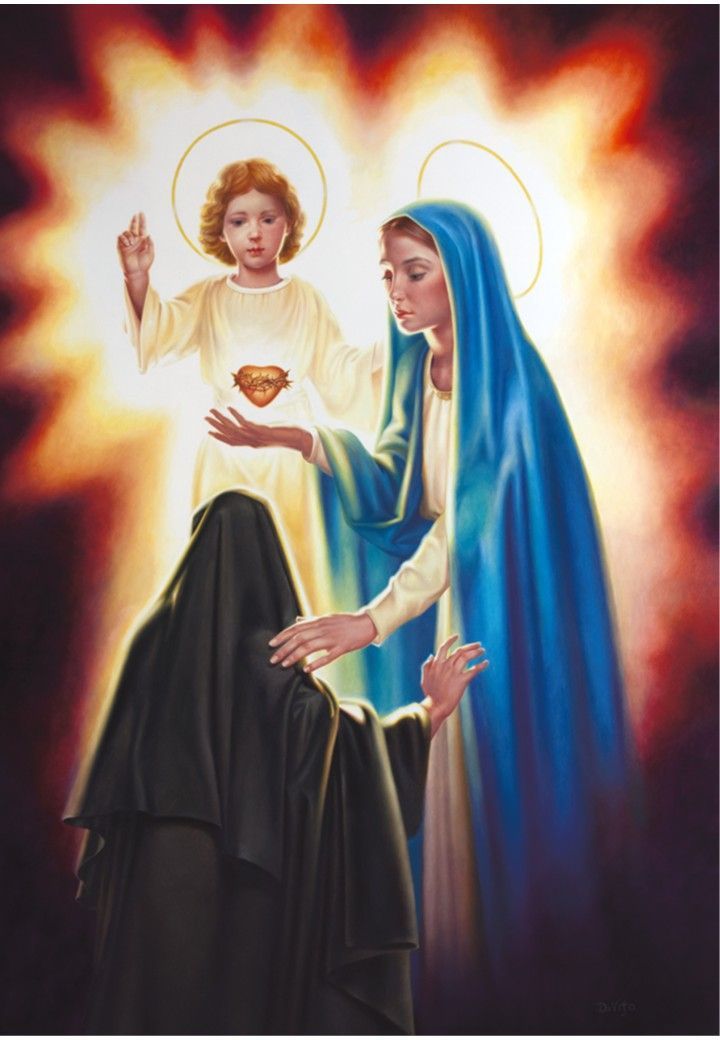
Our Lady opens her hands.
From them pours forth an intense light.
That light penetrates the children to the depths of their souls.
Yet it does not blind them.
It does not humiliate them.
It does not destroy them.
It enables them to see themselves as God sees them.
Is this not precisely what happens during a good confession?
An examination of conscience is not simply an attempt to remember sins.
It is allowing the light of God to illuminate the heart.
Light never exists in order to shame us.
It exists in order to heal us.
A physician must first see the wound before he can treat it.
So too does the Holy Spirit.
He reveals the truth.
Never in order to condemn.
Always in order to save.
The Immaculate Heart
Why, among all the signs of Fatima, does Our Lady reveal above all her Heart?
Because from the very beginning, humanity's deepest problem has never simply been our actions.
It has always been the condition of the heart.
It was Adam's heart that ceased to trust.
David's heart that surrendered to desire.
Peter's heart that broke beneath the weight of fear.
Paul's heart that was transformed on the road to Damascus.
Mary reveals her Heart because it is the first fully human heart entirely open to God.
Within it there is no selfishness.
No rebellion.
No resistance.
It is wholly receptive to divine love.
For this reason she says to Lúcia:
"My Immaculate Heart will be your refuge and the way that will lead you to God."
Notice those final words carefully.
The way.
Not the destination.
Mary never keeps anyone for herself.
Like her words at Cana, her whole mission can be summed up in one sentence:
"Do whatever He tells you."
She always leads beyond herself.
Always towards Christ.
Two Hearts, One Mission
The spirituality of Fatima is, at its heart, the spirituality of two Hearts.
The Immaculate Heart of Mary.
And the Sacred Heart of Jesus.
These are not two separate devotions.
They are one single path.
Mary's Heart is the most perfect reflection of the Heart of her Son.
The more closely we contemplate her, the more perfectly we learn to love as Christ loves.
Perhaps this is why the Church places the Solemnity of the Sacred Heart during the month of June.
Fatima quietly leads us there.
To Calvary.
To the pierced side of Christ.
To the fountain from which the whole Church receives life.
The Meaning of Reparation
Many people struggle with one particular word that belongs to the Fatima message:
Reparation.
Does God somehow need compensation?
Has He been offended in the human sense of the word?
Certainly not.
Love cannot cease to love.
Imagine a child who has deeply hurt his mother.
Does her love disappear?
Never.
Yet the child who truly loves longs to embrace her, to apologise, to make amends—not because he is forced to do so, but because love naturally seeks to heal what has been wounded.
This is how the saints understood reparation.
Not as an attempt to persuade God to forgive.
But as love responding to Love.
Saint Margaret Mary Alacoque heard Christ say:
"Behold this Heart which has loved humanity so much, yet receives in return so much indifference."
Fatima is Heaven's answer to that sorrow.
Not through fear.
But through love.
The First Saturdays – A School of the Heart
Only now do we begin to understand the true meaning of the First Saturdays.
They are not a spiritual formula.
Nor a checklist of religious obligations.
They are a school of the heart.
Our Lady leads us through four simple steps.
First, confession.
Because the heart must first be cleansed.
Then Holy Communion.
Because a purified heart must be filled with divine life.
Then the Rosary.
Because the heart must gradually learn to see the world through Mary's eyes.
Finally, fifteen minutes of quiet meditation.
Because love always requires time.
No relationship flourishes in haste.
The First Saturdays are therefore not merely a monthly devotion.
They are a lifelong formation of the heart.
What Is the World Apostolate of Fatima?
This brings us to perhaps the most important question of all.
What truly is the World Apostolate of Fatima?
Is it simply an organisation that promotes devotions?
A group that spreads the Fatima message?
Certainly these things matter.
But they are not its deepest purpose.
The Apostolate truly begins when a person's heart begins to beat in harmony with the Hearts of Jesus and Mary.
It is seen in the person who not only prays the Rosary, but learns to forgive.
Who not only observes the First Saturdays, but makes reparation through daily acts of kindness.
Who not only speaks about mercy, but becomes merciful.
The world does not need ever more pastoral programmes.
It needs hearts transformed by grace.
The Eucharist – The Spring That Never Runs Dry
Every sincere confession naturally leads to the Eucharist.
This is no coincidence.
The father in the parable does not end his forgiveness with an embrace.
He prepares a banquet.
So too does Christ.
The confessional is the road.
The altar is home.
In confession we receive forgiveness.
In the Eucharist we receive God Himself.
There the Heart of Jesus continues to beat for every human heart.
Grace does not merely preserve spiritual life.
It causes that life to grow.
Every Holy Communion received with a pure heart is like entering once more into the living spring that can never run dry.
This is why Our Lady continually led the children towards the Eucharist.
Even before her apparitions, the Angel of Peace prepared them through adoration and acts of reparation.
He did not begin with activity.
He began with kneeling.
As though Heaven wished to teach us that we cannot hope to change the world until our own hearts have first been transformed in the presence of God.
Coming Home
At the end of this journey we return to the very first question in the Bible.
"Where are you?"
After thousands of years, the Prodigal Son finally gives humanity's answer.
He comes home.
Not because he has repaired everything.
Not because he has become perfect.
But because he dares to believe that the Father is still waiting.
This is the deepest meaning of the Sacrament of Reconciliation.
It is not primarily an encounter with our sins.
It is an encounter with the Father.
It is not a place of humiliation.
It is the place where our dignity is restored.
It is never the end.
It is always a new beginning.
This is precisely where Our Lady of Fatima wishes to lead every soul.
To the fountain opened in the pierced side of her Son.
To the confessional, where grace restores life to the heart.
To the Eucharist, where that renewed heart is nourished by God Himself.
For the Christian who truly lives the spirituality of Fatima is no longer driven by fear of punishment.
He lives in gratitude.
Day by day he discovers that the greatest miracle is not simply that God forgives sins.
The greatest miracle is that He never grows weary of seeking His children.
And when, at last, a soul responds to His call, it discovers that every step of its journey has been leading towards one place alone— the open Heart of Christ, from which there flows without ceasing the inexhaustible fountain of mercy, grace and everlasting life.
By Father Marcin Budzinski
A Catholic priest, born in Poznań, in western Poland, in 1980. A physicist and biologist by training, and a teacher by passion; he graduated from the Archdiocesan Seminary in 2012 and was ordained for the Archdiocese of Poznań; his main academic interests are the natural sciences and philosophy, on which he wrote his master’s thesis; he worked mainly in secondary schools with young people, whom he evangelised through theatre; his dream was to work abroad; for the past three years he has been working with the Polish Catholic Mission in England and Wales; he is dean of the north-western deanery of the Polish Catholic Mission and parish priest in Lancaster; he is deeply devoted to Our Lady of Fátima and to the devotion to Divine Mercy.