
O Our Lady of Fatima, my Mother gentle and true,
As Lent draws near, I run to you.
You taught the children long ago, how God’s great love still longs to grow.
Help me feel that love today, and hear your whisper when I pray:
“Offer everything to God above; each little act, each gift of love.”
This holy Lent, when days feel long, when doing right feels tough, not strong
O Mother, remind me penance is a way, to walk with my Loving Jesus every day.
Lift me up when I fall down, and guide me with your shining crown
To carry the Cross He had to bear, with tiny gifts of love and care.
Lent invites us with Christ into the desert
Our Lady of Fatima teaches us how to walk there…
On the 13th May 1917 in Fatima, Our Lady explicitly asked the three shepherd children: “Are you willing to offer yourselves to God and bear all the sufferings He wills to send you, as an act of reparation for the sins by which He is offended, and of supplication for the conversion of sinners?” “Yes, we are willing.” was their replies. Little St Jacinta received many visits from the Blessed Virgin Mary before dying. Venerable Sr Lucia recalls one of the conversations where St Jacinta says: “...I want to suffer for love of Our Lord and for sinners. Anyway, I don’t mind! Our Lady will come to me there and take me to heaven.” At times she kissed and embraced a crucifix, exclaiming: “O my Jesus, I love You, and I want to suffer very much for love of You.” (Fatima in Lucia’s own words, vol 1, page 62.)
Suffering, penance, and the cross stand at the heart of Christian holiness, not as a cult of pain but as a mysterious path to love. For example, the saints who bore the stigmata show that when suffering is united to Christ, it becomes a place of virtue, mercy, and deep transformation.
Padre Pio: Sharing Christ’s Wounds
Padre Pio of Pietrelcina spent most of his priestly life in San Giovanni Rotondo, where he became known for the stigmata—wounds corresponding to those of Christ—which he carried for about fifty years. In September 1918, while praying before a crucifix in the monastery chapel at San Giovanni Rotondo, he received these wounds as he contemplated the crucified and suffering Jesus.
For Padre Pio, the stigmata were not a badge of honour, but a participation in Christ’s cross, accepted as a mission of love for souls. He endured physical pain, misunderstanding, and even restrictions placed on his ministry, yet responded with obedience, charity, and tireless dedication to the confessional and the Mass. He never questioned his superiors and the orders of the magisterium. He showed extreme dedication to his ministry and to Jesus Christ. The Child Jesus comforted him during his time of difficulty and when he was attacked by the devil. In him we see that suffering becomes fruitful when it is offered—for conversion, for the Church, for those who are far from God—rather than turned inward in bitterness. His love and dedication to Our Blessed Virgin was admirable. It was said that Padre Pio had a statue of Our Lady of Fatima kept near the sacristy and he would greet her and pray before her before and after Mass, deepening the bond between his own life of suffering and intercession and the call of Fatima to prayer, penance, and devotion to the Immaculate Heart.
Saint Francis: Joy in the Crucified
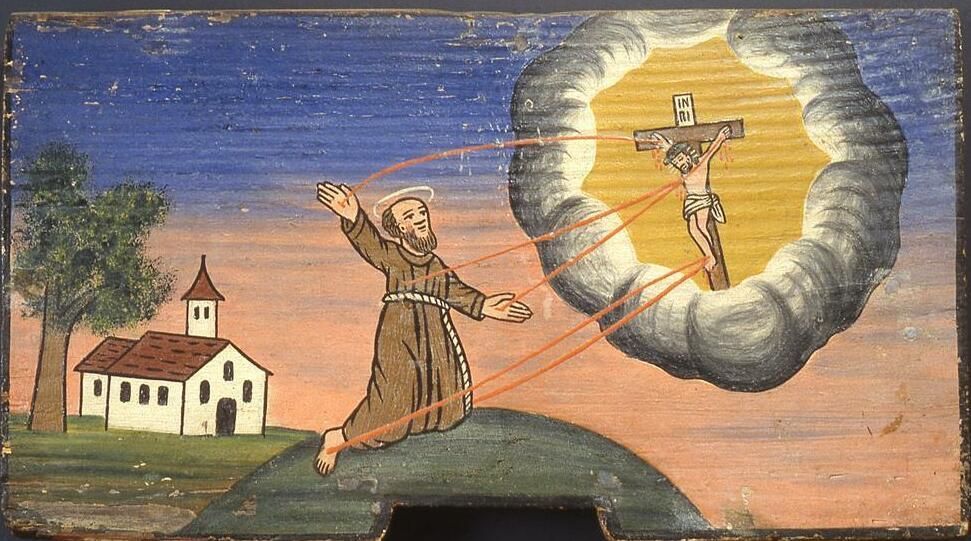
Saint Francis of Assisi, the first recorded stigmatist, received the wounds of Christ while praying in solitude on Mount La Verna and beholding a vision of a crucified, radiant seraph. After this event, his life was marked by deeper illness and weakness, yet also by a remarkable joy and gentleness toward others.
Francis’ stigmata teaches us that to be configured to Christ crucified is also to be configured to Christ meek and humble of heart. He did not use his suffering to separate himself from people but to draw closer to lepers, the poor, and the forgotten, seeing in them the suffering Christ whom he bore in his own flesh. In him, penance is not self-hatred; it is a continual turning from sin and pride toward a love that embraces the cross for the sake of peace and reconciliation.
In this Jubilee year of 2026, the Church marks the 800th anniversary of Saint Francis’s Paschal journey—his death and birth into heaven. The commemoration of his life is a concrete path of grace and interior renewal for those who seek to follow Christ with the same burning love.
Saint Catherine and Hidden Suffering
Saint Catherine of Siena received the stigmata during Lent, yet, according to tradition, the marks were visible only to her during life and appeared outwardly only after death. She thus lived a paradox: deeply united to the Passion, but with wounds that remained hidden, known principally to God.
Catherine poured out this interior suffering in tireless service to the Church—advising popes, reconciling enemies, urging reform and holiness. Her example reminds us that the holiest suffering is often unseen: the quiet patience with family, the hidden endurance of illness, the daily fidelity to prayer when God feels silent. In such hidden crosses, humility grows, and the soul learns to love without needing recognition.
Saint Rita: Sharing The Thorn of Christ
Saint Rita of Cascia’s life is a contemplation of the cross, where suffering, penance, and love are woven together. As a young wife, she endured years of harshness and domestic violence, offering patience and prayer instead of resentment, and later forgave the murderers of her husband. Widowed and bereaved of both sons, she entered the Augustinian convent, embracing a life of austerity, charity, and intercession for sinners. Deeply devoted to the Passion, she prayed to share in Christ’s redemptive suffering, and at about sixty received a single thornwound on her forehead, a form of stigmata, while meditating before the crucifix. This painful, often foulsmelling wound marked her remaining years with hidden humiliation and constant physical trial, yet she bore it with serenity and even joy. In Rita, the cross is not a tragic endpoint but a narrow gate into deeper union with Christ, showing that when suffering is accepted in faith and offered for others, it is transformed into a mysterious fruitfulness for the Church and a path of sanctity for the soul.
Marie Julie Jahenny and Yvonne Aimée: Consoling the Heart of Jesus
Marie Julie Jahenny, a French mystic of the 19th and early 20th centuries, is remembered as a stigmatist whose life was filled with extraordinary sufferings and reported mystical experiences centred on reparation for sin. Accounts of her life emphasize that she offered her pains as a response to the offences committed against the Heart of Jesus, seeing herself as a victim soul called to make up, in love, for the coldness and indifference of many. In her, we glimpse a particular form of penance: freely accepted expiation, not imposed by God but embraced as a gift to console Christ and intercede for the world.
Yvonne Aimée de Malestroit, not as widely known as Padre Pio or St Francis, remains a hidden gem of Catholic mysticism. She was a 20th century French religious, also associated with mystical graces and intense physical and spiritual trials borne in union with Christ. Her spirituality combined tender trust in Jesus—especially in his mercy—with courageous endurance of suffering for the sake of others. Through her story, we see that even in an age of war, confusion, and unbelief, Christ still raises up souls who choose to stand beside him at the cross, praying and offering themselves for those who do not yet know his love. Their witness encourages us to see our trials not as meaningless accidents, but as occasions to say, quietly and sincerely, “Jesus, I trust in you.”
A Message of Virtue in Suffering
The stigmatized saints do not glorify pain for its own sake; they reveal how grace can transform suffering into a school of virtue. From them we learn:
Faith: to see in every cross—great or small—a chance to be closer to the crucified Lord.
Hope: to believe that no suffering offered in love is wasted, that God can draw good even from what we least understand.
Charity: to let our own wounds make us more compassionate, gentler with others, quicker to forgive.
Humility: to accept that we are not saviours, but instruments, content that God alone sees the full value of our sacrifices.
St Padre Pio, Saint Francis, Saint Catherine, Saint Rita, Marie Julie Jahenny, Yvonne Aimée and other stigmatists stand beneath the cross not as tragic figures but as living icons of Christ’s words: “Whoever wants to be my disciple must deny himself, take up his cross daily, and follow me.” Their lives invite us to bring our illnesses, failures, loneliness, and daily frustrations to the foot of the crucifix and to whisper a simple prayer: “Lord, do not let this suffering be wasted. Make it an act of love.” In that surrender, the cross ceases to be only a symbol of pain and becomes, even in the midst of tears, the tree of life.