
The apparitions at Fatima, Pontevedra, and Tuy represent a profound theological "call to arms." At their core is a challenging message that mirrors the words of St. Paul to the Colossians: "I am filling up what is lacking in the afflictions of Christ on behalf of his body, which is the church" (Col 1:24).
This statement often startles. How could Christ’s infinite sacrifice on the Cross be "lacking"? The message given to the three shepherd children—Lucia, Francisco, and Jacinta—clarifies this mystery. While Christ’s Passion is sufficient for the salvation of all, God invites human participation to apply those graces to individual souls. Through penance and sacrifice, we become co-redeemers in the mystical body of Christ.
The words penance and reparation are often used interchangeably in a spiritual context, although they have a distinct focuses and functions. A simple way to distinguish them is to look at their direction: penance looks back at a debt due to our sinfulness, while sacrifice looks forward, with an offering of love by self-denial for either ourselves or for someone else as an act of reparation (including for the holy souls in purgatory).
Penance is primarily concerned with reconciliation and healing. An example could be going to confession and saying prayers of reparation or performing an act of service to “make up” for a previous act of selfishness.
Sacrifice is a broader act, of voluntary surrendering, of something good for the greater good. It is an act of love to God, in joining our little sacrifice, with Christs death on the cross being the ultimate sacrifice which he made for us. An example could be likened to a mother skipping a meal so her child can eat (sacrifice of comfort).
The Call of Fatima: Reparation
In 1917, the Angel of Peace and later the Virgin Mary introduced a radical concept to the children: the power of "offering it up." They were asked to pray and make sacrifices for sinners who had no one to pray for them. The Cross was not just a historical event to be admired, but a living reality to be shared.
The children’s response—fasting, wearing tight cords, and enduring the heat—wasn't about self-punishment for its own sake. It was an act of reparatory love. By choosing to suffer small crosses, they sought to console the "Hidden Jesus" and pull souls back from the brink of spiritual ruin.
Pontevedra and Tuy: The Thorns of the Heart
The message evolved in the subsequent visions granted to Sister Lucia at Pontevedra (1925) and Tuy (1929).
- At Pontevedra, the Child Jesus and Mary requested the Five First Saturday’s devotion. The imagery was vivid: Mary’s heart was encircled by thorns—representing the blasphemies and ingratitude of humanity. Sacrifice here took the form of the First Five Saturdays devotion: Confession, Holy Communion, Rosary and meditation.
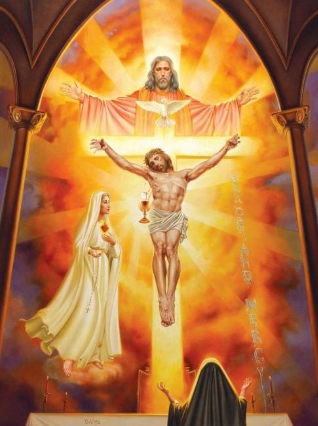
- At Tuy, Lucia witnessed the Trinitarian vision. Under the left arm of the Cross, large drops of "grace and mercy" fell upon the altar. This reaffirmed that the sacrifice of the Cross is perpetually present in the Eucharist.
Filling Up the Afflictions
St. Paul’s "missing" element is our consent. Christ died for everyone, but He will not force His grace upon anyone. When we embrace our daily crosses—illness, rejection, or the simple discipline of prayer—we provide the "yes" that allows Christ’s grace to flow into the world.
The Fatima message reminds us that the Cross is the only path to the Resurrection. St Therese of Lisieux said sacrifice is the fruit of love; it is the way we prove that our devotion isn't just a feeling, but a will aligned with God's.
By uniting our small, finite pains with Christ’s infinite suffering, we don't just "endure" life; we transform it into a tool for the salvation of others. In the words of the Fatima prayer, we do it "for love of Jesus, for the conversion of sinners, and in reparation for the sins committed against the Immaculate Heart of Mary."
Article written by Patrick Cunningham 8 Feb 2026
Source Reference: Sister Lucia's memoirs and AI search with SD check by Canon Jason