
My Reflective Account of the Visitation of the National Pilgrim Virgin Statue of Our Lady of Fatima together with the Relics of Saints Francisco and Jacinta to the Ukrainian Catholic Eparchy of the Holy Family (Ukrainian Catholic Cathedral)
My journey towards the visitation of the National Pilgrim Virgin Statue of Our Lady of Fatima, together with the relics of Saints Francisco and Jacinta, to the Ukrainian Catholic Cathedral began quietly on 7 March 2026. After the previous parish visitation, we brought the statue, her crown, the relics, and other essentials to the Cathedral. Entering through the back door, climbing up to the music room, and meeting Father Vitaly, I found myself filled with questions. There was a deep sense of anticipation—this was no ordinary visit. This would be the first time the National Pilgrim Virgin Statue would come to the Ukrainian Cathedral in London. Something historic was about to unfold, and I was both curious and expectant.
Day 1 – 13 March 2026
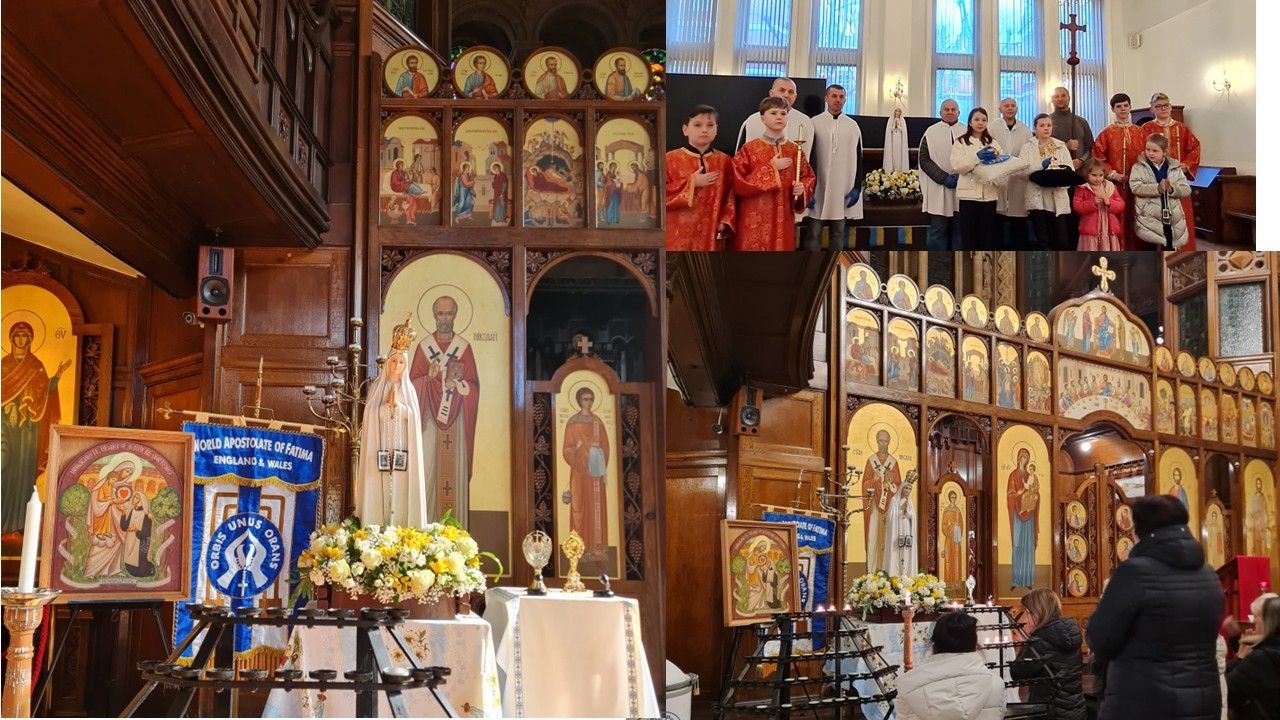
When I entered the Cathedral, I was immediately struck by its beauty. The icons, rich and luminous, surrounded the space in a way that felt both ancient and alive. It was unlike any Roman Catholic church I had previously visited. Sitting quietly at the back with my fellow volunteers, I found myself simply absorbing everything—the stillness, the sacredness, the sense of stepping into something far greater than myself. Above all, I was reminded that I was in the presence of Jesus in the tabernacle.
A comment from Brother Oliver Abasolo stayed with me—he said that Jesus is in the sanctuary, the “Holy of Holies.” That phrase stirred something within me. What lay behind the iconostasis? What mysteries were hidden there? My curiosity deepened, but so did my reverence.
Soon, the stillness gave way to movement. People began to gather—the men chosen to carry Our Lady, their faces marked with quiet honour; the acolytes in festive vestments; the children entrusted to carry the crown and the relics. There was excitement, yet it was wrapped in a profound silence, a shared understanding that something sacred was about to take place.
Then Bishop Kenneth entered. His presence was striking—not because of grandeur, but simple humility. His warm smile and gentle authority immediately set the tone. It was my first time seeing a bishop in Eastern vestments, his black headdress and black and gold-adorned robes adding to the richness of the moment.
The procession began outside. As the procession of Our Lady entered into the Cathedral, the space gradually filled with the faithful. It was a powerful sight—Our Lady being crowned, and the Eparchy being consecrated to her Immaculate Heart. It felt as though heaven and earth briefly touched.
The Divine Liturgy followed, celebrated in Ukrainian. Though I did not understand the words, I understood something deeper. The rhythm, the incense, the gestures—all spoke of reverence. Their prostrations were particularly moving. It was worship expressed not just in words, but through the whole body.
The liturgy was long, yet no one seemed restless. There was patience, attentiveness, and devotion. In that moment, I realised that this, too, is the Catholic Church—ancient, diverse, yet united. Different expressions, yet one sacrifice.
That night, I went home reflecting, already eager for what the next day would bring.
Day 2 – 14 March 2026
This day remains etched in my heart for three reasons: an encounter, a realisation, and a deeper understanding of hope.
During a tea break, I stood before a large frame filled with photographs of men. Curious, I asked a woman nearby who they were. In her halting English, she explained—they were those who had died in the war.
Her words carried weight. She shared that some of her family members were still in Ukraine. Her sister had chosen to stay, as her husband was fighting. The fear in her voice was unmistakable. It was not abstract—it was personal, immediate, real.
In that moment, the war ceased to be distant news. It became human.
I tried, in my limited way, to offer encouragement, reminding her of Our Lady’s intercession. We spoke about faith, about prayer, about hope. By grace, our conversation led her to join the apostolate. It was a small but beautiful reminder that even in sorrow, seeds of faith continue to grow.
Throughout the day, I observed how the faithful approached Our Lady. They came not out of routine, but with urgency—kneeling, weeping, and whispering prayers. Some sat silently, tears streaming down their faces. One woman, in particular, wept quietly as she waited. There was no need for words. Her pain spoke for itself. And yet, so did her faith.
I realised then that their devotion should not be surprising. Ukraine has long been entrusted to the Blessed Virgin Mary, honoured as the Queen of Ukraine. Their love for her is deeply rooted, not only in history, but in lived experience.
Later that day, I attended the Divine Liturgy celebrated in English. For the first time, I could fully follow the words. Yet what struck me most was the Eucharist. Receiving Holy Communion in both species, administered by spoon, was a profoundly tangible experience. Seeing the Body dipped into the Precious Blood, I was confronted with the reality of what I was receiving Jesus Himself, literally “gnawing His flesh”. The words of Bishop Barron, in his homily about partaking the Body of Christ (John 6 ) came alive in a new way. This was no abstraction. This was participation in a divine mystery.
Day 3 – 15 March 2026
The final day arrived with a mixture of gratitude and humility.
The Cathedral was filled beyond capacity, especially during the morning liturgy. People stood wherever they could find space. And yet, despite the crowd, there was reverence. Silence. Attention. A shared focus on the sacred worship.
What moved me deeply was not just their faith, but their generosity. Despite the ongoing suffering in their homeland, they gave freely. Their petitions—nearly 500 in total—revealed hearts turned towards God, pleading, trusting, hoping. And their generosity extended beyond prayer.
I was also struck once again by Bishop Kenneth’s humility. His leadership was not distant, but personal. He engaged with people warmly, attentively—a shepherd truly present to his flock.
Final Reflection
As the visitation came to an end, I was left with a profound sense of humility and gratitude.
I was humbled by their way of worship—their reverence, their prostrations, their wholehearted prayer. I was inspired by their faith in the midst of suffering. And I experienced true humility in the unity of the Church—a reminder that, despite differences in language and expression, we are one Body in Christ.
As the Cathedral is named after the Holy Family. The plight of the Ukrainian people brought to mind the Holy Family’s flight into Egypt—displaced, uncertain, yet trusting in God’s providence. That same trust is alive today.
Above all, I am grateful—to Jesus, for the gift of the Eucharist; to Our Lady, for her constant intercession; and for the privilege of witnessing such faith. This visitation was not just an event. It was an encounter—with beauty, with suffering, with faith, and ultimately, with God.
May God be praised. Ave Maria.
Marie Yakeza Te-Mendoza