
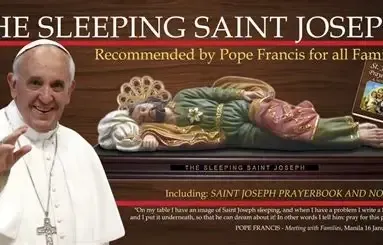
Pope Francis, in Patris Corde, calls Joseph a father “in the shadows,” praising his “creative courage.” His devotion to Sleeping St Joseph; entrusting petitions beneath a small statue, captures something essential: Joseph’s silence is not passive. It is the silence of a man who listens deeply to God, even in sleep.
Under The Loving Command of His Creature – St Joseph, The Worker (1st May)
St Joseph remains one of the most astonishing figures in salvation history: the man chosen for the greatest earthly mission after Our Lady, and yet the most hidden; the guardian of the Redeemer, and yet the most silent; the protector of the Word made Flesh, and yet the one whose own words never appear in Scripture. His silence is not emptiness. It is revelation.
Joseph’s entire life is a living “yes” to God, spoken not with the tongue but with the total obedience of his heart. When the angel appears in a dream, Joseph does not question. He rises. When the Child is threatened, he does not hesitate. He flees into the night. When the Holy Family returns to Nazareth, he does not seek honour. He works, day after day, shaping wood while the Creator of the universe grows under his roof.
Here lies one of the most breathtaking mysteries of the Christian faith: Joseph commanded God. The eternal Son, in assuming true humanity, submitted Himself to Joseph’s fatherly authority. As St Bernard wrote, “He to whom angels submit Himself was subject to Joseph.” St John Paul II echoes this in Redemptoris Custos, noting that Joseph’s fatherhood is expressed “in the total gift of self, in his life of work,” and that Jesus “obeyed him” in the home of Nazareth. The Almighty allowed Himself to be led, taught, and protected by a silent carpenter.
This hidden greatness was confirmed in a striking way at Fatima. During the final apparition on 13 October 1917, as the Miracle of the Sun unfolded, the children saw St Joseph appear in the sky with the Child Jesus. St Joseph blessed the world, tracing the Sign of the Cross with the Son in his arms. Heaven itself revealed Joseph’s continuing mission: to guard the Church as he once guarded Christ, and to bless the world with the same quiet authority entrusted to him in Nazareth. Fatima thus unveils Joseph not only as a figure of the past but as a father for our times; active, present, and powerful in his intercession.
It is remarkable that the Church took centuries to fully recognise St Joseph’s splendour. His vocation was so interior, so free of self‑assertion, that even the early Church needed time to perceive the magnitude of the man who lived in the quiet shadows of Nazareth. Yet holiness cannot remain hidden forever. Slowly the Church began to see what Heaven had always known: that Joseph’s mission was unparalleled; that he loved Mary with a purity unmatched; that he protected Jesus with a courage beyond compare, that he lived the Beatitudes before they were ever preached.
In a world overwhelmed by noise, Joseph’s silence is prophetic. In a culture obsessed with visibility, his hiddenness is liberating. In a time, restless for recognition, his humility is healing.
On this feast of St Joseph the Worker, we honour the man whose life was a perfect harmony with God’s will. The man who spoke no words yet proclaimed the Gospel with his actions. The man who commanded God with fatherly love, who blessed the world at Fatima, and who now intercedes for the Church with that same quiet strength. The man whose silence still speaks gently, powerfully and eternally.
St Joseph, pray for us.
Bibliography
- Bernard of Clairvaux, Homilies on the Gospel.
- John Paul II, Redemptoris Custos (1989).
- Francis, Patris Corde (2020).
- Sister Lúcia, Fatima in Lucia’s Own Words.
- Vatican Archives on the Fatima Apparitions (1917).