
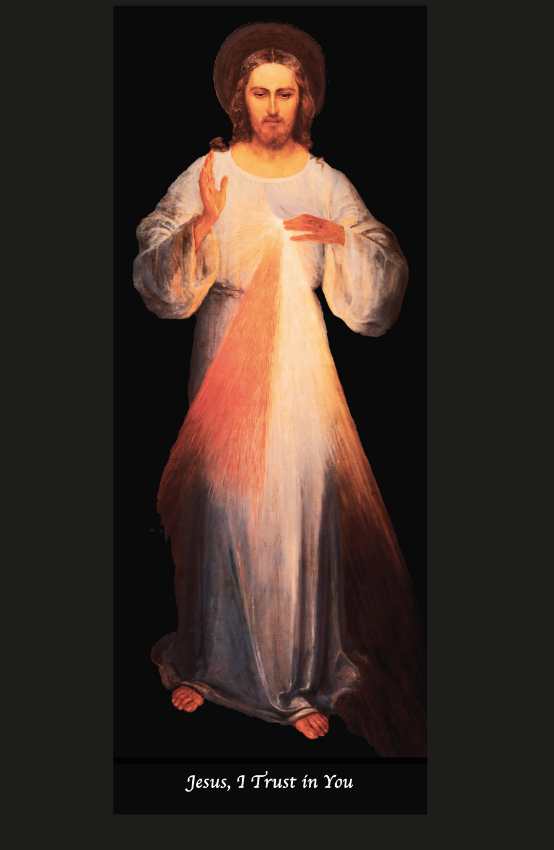
Just one week after Easter, the Church brings us to Divine Mercy Sunday, a feast that is not an added devotion or a spiritual “extra,” but a profound continuation of the Paschal mystery.
It draws our attention to the heart of the Gospel: that the death and resurrection of Jesus reveal a God whose mercy is stronger than sin, fear, and even death itself. In a world overshadowed by conflict and uncertainty, this truth becomes a source of hope that cannot be shaken.
The Angel of Peace, who calls humanity to repentance, reparation, and Eucharistic adoration, stands as a heavenly reminder that peace begins not in political strategies but in the human heart. Before peace can be built, it must be received. Before it can be shared, it must be adored.
The Risen Christ and the Gift of Peace
In the Sunday’s Gospel, the disciples are gathered behind locked doors, fearful and disoriented after the violence of Good Friday. Their world has been shaken by betrayal, injustice, and brutality. Into this atmosphere of fear, the Risen Christ enters and speaks the words that echo across every age: “Peace be with you.”
This is not a fragile peace. It is the peace of the One who has conquered death. It is the peace of a God whose mercy is not defeated by human cruelty. It is the peace that the Angel of Peace invites us to adore in the Eucharist, the peace that flows from the wounded Heart of Christ.
Jesus shows His wounds, not as reminders of failure, but as signs of a love that absorbs violence without returning it. These wounds are the wellspring of Divine Mercy. They reveal that God’s answer to sin is forgiveness, God’s answer to fear is peace, and God’s answer to death is life.
Adoration as the Path to Peace
The Angel of Peace taught the children of Fatima to bow low before the Eucharistic Lord, offering reparation for the sins of the world and praying for peace. This gesture of adoration is not passive. It is the beginning of transformation.
To adore Christ is to let His mercy reshape us. To adore is to surrender our fears, our resentments, and our helplessness before the One who alone can bring peace. To adore is to allow the Paschal mystery, Christ’s death and resurrection, to become the pattern of our own lives.
In a world wounded by war, adoration becomes an act of spiritual resistance. It refuses to let hatred have the final word. It opens the heart to the mercy that alone can heal nations, families, and individuals.
Thomas and the Mercy That Meets Us Where We Are
A week after Easter, Thomas, one of the 12 Apostles, encounters the Risen Lord. He is struggling, wounded by grief and confusion. Jesus does not rebuke him. Instead, He meets Thomas with tenderness, offering exactly what he needs to believe. Divine Mercy is always personal. It reaches into the places where fear, doubt, and sorrow have taken root.
Thomas’s journey ends with one of the most beautiful confessions of faith in Scripture: “My Lord and my God!” This is the cry of adoration. This is the cry the Angel of Peace invites us to make before the Eucharistic Christ. This is the cry that transforms the heart and opens it to peace.
Mercy Stronger Than the World’s Wounds
Divine Mercy Sunday reminds us that the Paschal mystery is not only something Christ accomplished long ago, it is something He continues to pour into the world today. His mercy is stronger than the wars that rage, stronger than the divisions that tear communities and families apart, stronger than the fears that trouble our hearts.
As we adore the Risen Lord, may the Angel of Peace guide us into deeper trust, deeper surrender, and deeper compassion. And may the mercy flowing from the Heart of Christ bring healing to our world, our communities, our families and our own hearts.
Praying the Divine Mercy Chaplet
The Chaplet is a simple yet powerful prayer given through St Faustina, prayed on ordinary rosary beads. It can be offered at any time, but especially at 3 p.m., the Hour of Mercy.
It is an act of adoration, intercession, and peace uniting our hearts to the Heart of Christ for the healing of the world.
1. Begin with:
- The Sign of the Cross
- (Optional) “You expired, Jesus…” prayer
2. On the Our Father bead:
- Our Father…
3. On the Hail Mary bead:
- Hail Mary…
4. On the Creed bead:
- I believe in God…
5. On each “Our Father” bead of the five decades:
- “Eternal Father, I offer You the Body and Blood, Soul and Divinity of Your dearly beloved Son, our Lord Jesus Christ, in atonement for our sins and those of the whole world.”
6. On each of the ten “Hail Mary” beads:
- “For the sake of His sorrowful Passion, have mercy on us and on the whole world.”
7. After five decades, repeat three times:
- “Holy God, Holy Mighty One, Holy Immortal One, have mercy on us and on the whole world.”
8. End with the Sign of the Cross.