Day 2:
Opening Prayer
Come, Holy Spirit, fill the hearts of your faithful
and kindle in them the fire of your love.
Send forth Your Spirit, and they shall be created.
and You shall renew the face of the earth.
O God, who by the light of the Holy Spirit,
did instruct the hearts of the faithful,
Grant that by the same Holy Spirit we may be truly wise
and ever enjoy His consolations.
Through the same Christ Our Lord. Amen.
From the Gospel according to St. John
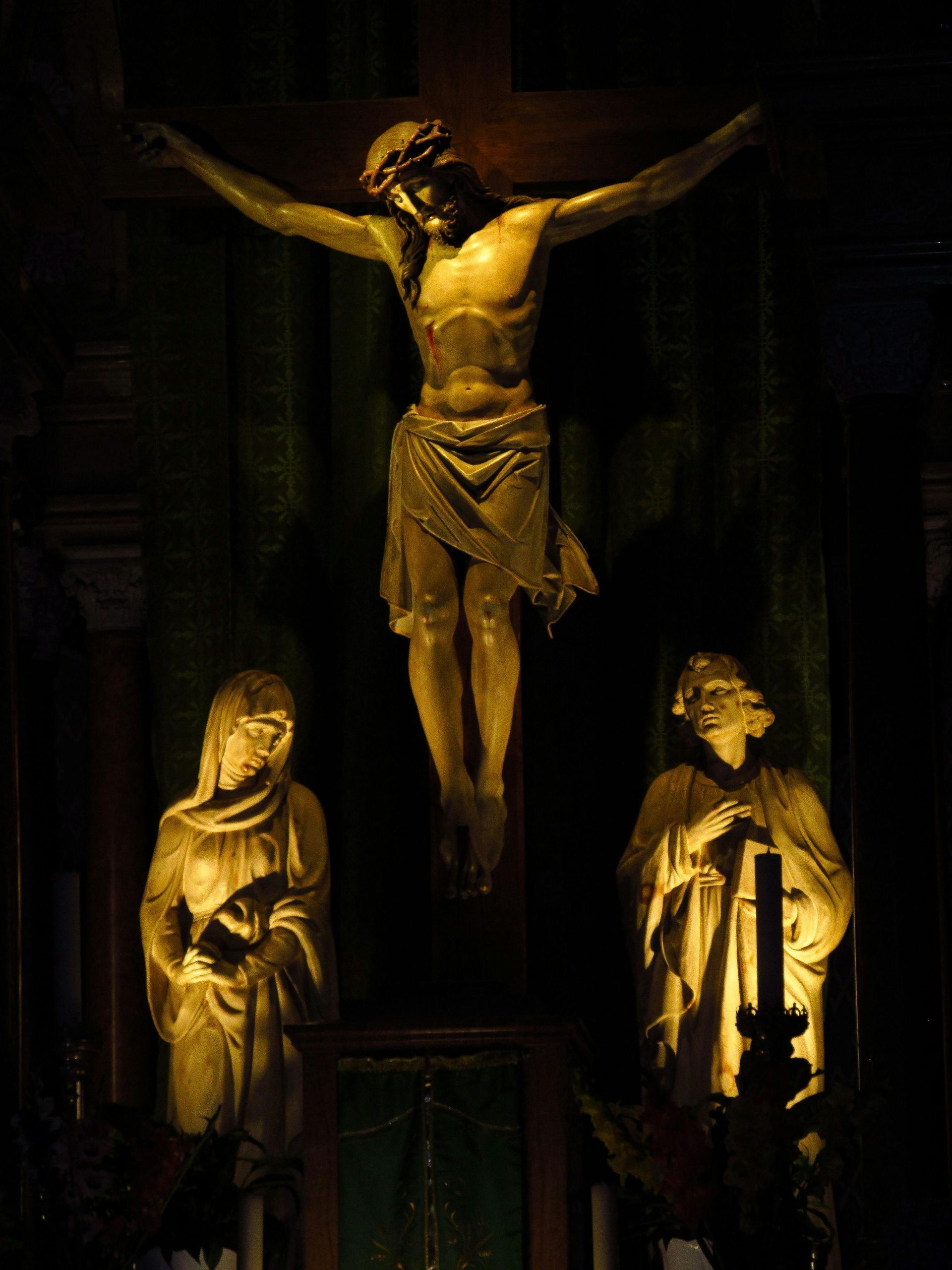
Standing by the cross of Jesus were his mother and his mother’s sister, Mary the wife of Clopas, and
Mary of Magdala. When Jesus saw his mother and the disciple there whom he loved, he said to his
mother, “Woman, behold, your son.” Then he said to the disciple, “Behold, your mother.” And from
that hour the disciple took her into his home. After this, aware that everything was now finished, in
order that the scripture might be fulfilled, Jesus said, “I thirst.” There was a vessel filled with
common wine. So they put a sponge soaked in wine on a sprig of hyssop and put it up to his mouth.
When Jesus had taken the wine, he said, “It is finished.” And bowing his head, he handed over the
spirit. Now since it was the preparation day, in order that the bodies might not remain on the cross
on the sabbath, for the sabbath day of that week was a solemn one, the Jews asked Pilate that their
legs be broken and they be taken down. So the soldiers came and broke the legs of the first and
then of the other one who was crucified with Jesus. But when they came to Jesus and saw that he
was already dead, they did not break his legs, but one soldier thrust his lance into his side, and
immediately blood and water flowed out. An eyewitness has testified, and his testimony is true; he
knows that he is speaking the truth, so that you also may (come to) believe. (Jn 19:25-35)
At the School of the Word: Lectio Divina on Jn 19:25-27
We access the heart of Kolbean spirituality and consecration to the Immaculata by placing
ourselves at the school of the word of God. The most emblematic text of Scripture for our purpose
is certainly John 19:25-27. St. Maximilian also referred to this text, admiring the loving plan of God
and dwelling on the exuberant gift of God’s love, which is represented by the Mother. “Another gift
yet…” he wrote, a gift that comes from the pure gratuity of the heart of God in Christ. This is what St.
Maximilian said: “Who would dare to imagine?...What could You have given me more, O God, after
having oKered Yourself to me to become mine? ...Your heart, inflamed with love for me, suggested
to You another gift; yes, yet one more gift! ...You asked us to become children, if we wish to enter the
heavenly kingdom. You well know that a child needs a mother. You Yourself established this law of
love. Your goodness, Your mercy, therefore, created for us a Mother, the personification of Your
goodness and infinite love. From the cross, on Golgotha, You oKered her to us and us to her...” (KW
1145).
Let’s read with St. Maximilian the source of this gift, there at Calvary, with Mary and John, to
grasp the meaning of this event for us today... Lectio on Jn 19:25-27 The context is solemn. We are
at the culmination of the life of Christ, when Jesus fully revealed His glory. He is on the Cross, the
cross that raises Him to heaven and from which He draws all people to Himself (cf. Jn 12:32). It is
the fulfillment of our salvation, the heart of the paschal mystery of Christ, the moment of the
supreme gift of love: “God so loved the world that he gave his one and only Son” (Jn 3:16). The
Father manifested that love through the gift of His Son in the Incarnation, and that mystery now
culminates in the gift of His life for us. In this solemn context occurs the gift of the Mother, the
penultimate act, we might say, of His giving Himself for our salvation. At verse 30, the Evangelist
tells us: “When Jesus had taken the wine, he said, ‘It is finished.’ And bowing his head, he handed
over the spirit.”
In this solemn context, the entrusting is of great value: the gift of the Mother is part of what Jesus
was to accomplish. It seems that all is finished after the entrusting of the disciple to the Mother and
the Mother to the disciple. v. 25: We find four women at Calvary, among whom the “Mother of Jesus”
stands out, and John refers to her using that title. Also in Cana he calls her by that title. v. 26-27: In
these verses we have what scholars call a “detection scheme”: Jesus sees - He says - Look... We
find this scheme again in John’s Gospel, where John the Baptist sees Jesus coming and says: “Look,
the Lamb of God” (cf. Jn 1:29-30; Jn 1:36). This literary scheme reveals the mission of the indicated
character. Therefore in the passage of the Cross, Jesus explains to the Mother what her mission is:
to be the mother of the disciple.
Closing Prayer
Hail Mary…
O Mary, conceived without sin, pray for us who have recourse to you, and for all those who do not
have recourse to you, especially the enemies of Holy Church and all those
recommended to you.