
Day 19:
Opening Prayer
Come, Holy Spirit, fill the hearts of your faithful and kindle in them the fire of your love. Send forth Your Spirit, and they shall be created and You shall renew the face of the earth. O God, who by the light of the Holy Spirit, did instruct the hearts of the faithful, Grant that by the same Holy Spirit we may be truly wise and ever enjoy His consolations.
Through the same Christ Our Lord. Amen.
Mary is the Virgin presenting offerings.
Mary, as stated in Marialis Cultus, is the example of that worship which consists in making our own life an offering pleasing to God.
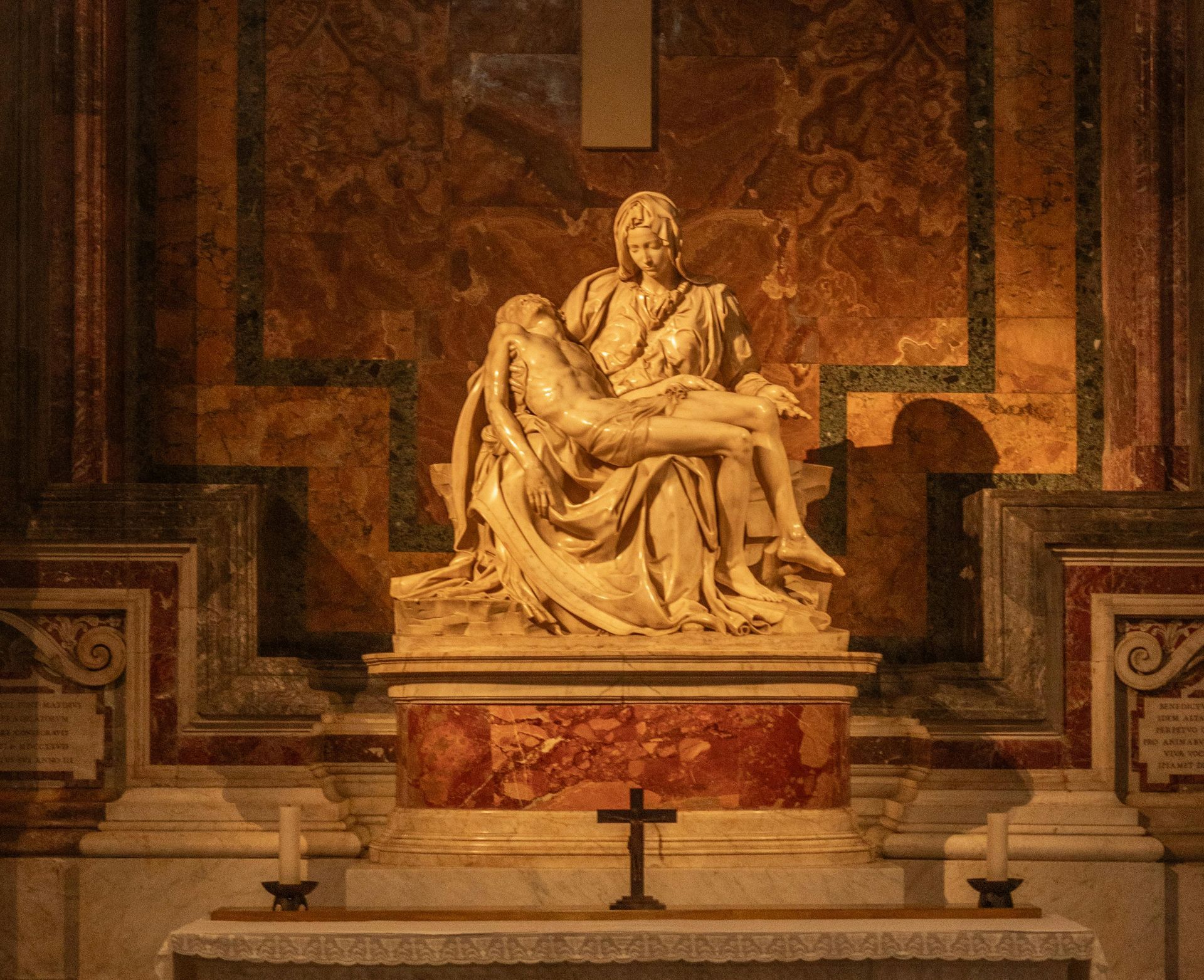
For her the “rejoice” of the Annunciation soon became “a sword will pierce your soul,” because that Child would be a sign of contradiction (Lk 2:35). It is an allusion to the passion of the Son which will become her passion. Mary shared from moment to moment the experience of the Son, and transformed her fiat into a daily stabat, faithfully adhering to the mission that the Father entrusted to her.
St. Maximilian called this stage of life “suffering out of love.”
Jesus did not come down from the Cross, Mary did not move away from the Cross. So Jesus has loved us!
He entrusted His cause to the Father and, as the Letter to the Hebrews says, the Father heard the Son who spoke to Him with prayers and supplications, with loud cries and tears (cf. Heb 5:7). Yes, Jesus was “heard because of His reverent submission,” as stated in Hebrews again. The Resurrection is the response to the confident surrender of the Son into his Father’s hands.
Mary was there because she also confidently entrusted her life to the Father. Mary knew that God does not fail in His promises. She had sung it in the Magnificat. Suffering is the result and consequence of love. St. Francis cried because “Love is not loved.”
This is true for us, too. St. Maximilian wrote that in human life there are three stages: preparation for work, work, and suffering out of love. Here his life is evidently described as in a fresco. The offer of life through the hands of Mary to Christ was the reason why St. Maximilian lived and died for love. In Auschwitz, his serenity was contagious because he had a certainty in his heart.
This is the last note he wrote to his mother before dying:
“My Beloved Mother, toward the end of May I came by a train to the Auschwitz camp. All is well with me. Beloved Mama, do not worry for me and for my health, because the good God is in every place and with great love He thinks about everyone and everything” (KW 961).
Go to previous prayer
| Go to next prayer
|
Go to the beginning